
How Long Do Dental Implants Last?
By Dr. Craig Misch, DDS, MDS | Board-Certified Implantologist
Published: June 2026
The honest answer is that the titanium post, once integrated, can last decades, and many patients keep their original implants for the rest of their lives. The crown or prosthetic sitting on top of that post is a different conversation entirely. Different material, different wear exposure, different replacement timeline. Conflating the two is where most of the confusion comes from when people try to get a straight answer on this question.
This post covers what actually determines how long implants last, what tends to cause failure when it happens, and what the prosthetic components are actually built for in terms of longevity.
Two Parts with Two Very Different Lifespans
A dental implant is usually talked about as a single thing, but it’s really two: the titanium post that goes into the jawbone, and the prosthetic sitting on top of it, whether that’s a single crown, a bridge, or a full-arch option like an All-on-4 or snap-in implant denture. The post and the prosthetic have entirely different relationships with wear and with time.
The Titanium Post
Titanium implant posts, once integrated with the jawbone through a process called osseointegration, are designed to be permanent. Clinical studies tracking implants over 20, 30, and in some cases 40 years show survival rates above 95% in healthy patients. Integration essentially makes the post part of the bone structure itself, and at that point, there’s nothing about the material or the design that pushes it toward a natural end date. Implants placed in the 1970s and 1980s are still in service. The constraint on longevity comes from what happens to the bone around the post over time, not from the post itself.
The Crown or Prosthetic
Crowns on implants, most commonly made from zirconia or porcelain-fused-to-metal, typically hold up for 10 to 15 years before showing meaningful wear. The prosthetic faces repeated bite force with every meal, and materials degrade under that load. A single-tooth crown in a patient who grinds their teeth will need replacement sooner than the same crown in a patient who doesn’t. For implant-supported dentures, the prosthetic is designed to be remade periodically while the underlying implants continue functioning. Snap-in dentures are a clear example: the snap attachments are serviced every few years, and the implant posts underneath can serve for decades without replacement.
What Actually Controls How Long Your Implants Last
Bone Quality at Placement
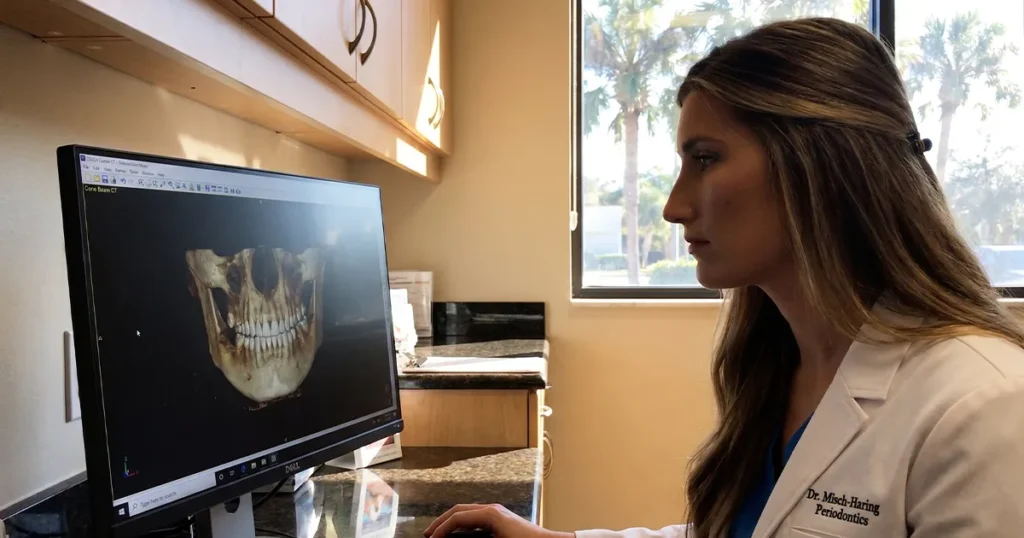
The longevity of an implant starts with the bone it’s placed into. Implants need sufficient volume and density to integrate and stay stable under load. When bone volume isn’t adequate at the time of placement, bone grafting addresses that before the implant goes in. Skipping it when it’s genuinely indicated is one of the more reliable paths to early failure. The 3D imaging done before any implant surgery at Misch shows exactly what the bone looks like, where density is adequate, and where it isn’t, and that read informs every placement decision.
Peri-implant Health Over Time
Bone loss around an implant after placement is the most common driver of long-term failure. The condition is called peri-implantitis: bacterial accumulation causes inflammation, which causes bone loss, which compromises the implant’s structural support. Patients with a history of gum disease who are considering implants should have that addressed before placement, and should be on an active maintenance schedule afterward. Research on peri-implantitis rates among patients who skip regular implant maintenance consistently shows worse outcomes, and the trajectory once significant bone loss has occurred is harder to reverse.
What Patients Control
Smoking is the single largest controllable risk factor. It restricts blood flow to the gum tissue, impairs healing, and roughly doubles the rate of peri-implantitis. Most implant specialists will discuss smoking cessation before proceeding, and for good reason: long-term outcomes in active smokers are meaningfully worse than in non-smokers or patients who quit before treatment. Beyond smoking, teeth-grinding (bruxism) puts abnormal stress on the prosthetic and the implant connection, and a night guard catches that when it’s identified early.
Regular maintenance is the other variable patients control directly. Implants don’t develop cavities, but the gum tissue around them needs the same monitoring any natural tooth receives. At Misch, implant maintenance is handled by Natalie Rosbury, RDH, who specializes specifically in implant maintenance, which involves different probing, different instrumentation, and a different monitoring protocol than a standard prophylaxis appointment.
When Implants Fail and Why
Early Failure (Within the First Year)
Most early failures happen before osseointegration is complete, in the three to six months after placement. Common causes include inadequate bone at the placement site, infection, premature loading before integration is finished, or systemic factors that impair healing. Early failure is the exception in a well-planned case with appropriate patient selection. Placement by an experienced surgeon in a well-diagnosed site produces integration success rates above 95% consistently in the clinical literature.
Late Failure (After Integration)
Late failure is almost always tied to peri-implantitis. Once bone loss around the implant crosses a threshold where structural support is no longer sufficient, the implant becomes mobile and must be removed. Catching early-stage peri-implantitis is routine with consistent monitoring. The point where outcomes get complicated is when it’s caught after significant bone loss has already occurred, which is why the maintenance visits that include probing around implant sites are doing real clinical work, not just box-checking.
How Misch Plans for Longevity from the Start
Surgical and Restorative Planned Together
The decisions made before the first incision determine a significant part of how long an implant stays functional. Placement angle, implant diameter, crown height space, and prosthetic design relative to bite load: these don’t operate independently. They interact with each other and with the patient’s anatomy in ways that accumulate over decades. At Misch, Dr. Maggie Misch-Haring handles the surgical side and Dr. Harry Haring handles the prosthetic, and both are at the table from the first appointment. The alternative, surgery placed by one provider with the prosthetic designed later by someone who wasn’t involved in the surgical plan, is a documented source of prosthetic complications that good upfront coordination would have prevented.
The Clinical Foundation Behind Each Case
For complex cases involving limited bone, unusual anatomy, or full-arch rehabilitation, Dr. Craig Misch’s published work on bone augmentation and implant loading protocols is part of the clinical foundation at this practice. His textbook on horizontal and vertical bone augmentation is used in clinical training programs internationally, which isn’t a marketing point so much as a description of the level at which implant biomechanics and planning decisions are understood here. That depth matters when the case involves anything other than straightforward placement into adequate bone.
Longevity for Full-Arch Implants
Fixed Full-Arch Bridges (All-on-4)
For patients replacing a full arch with All-on-4 dental implants, the longevity question has two layers. The implant posts follow the same long-term pattern as single implants: decades of function is realistic with healthy bone and consistent maintenance. The full-arch bridge attached to those posts is designed for a 10-15 year replacement cycle with good care, similar to a single-tooth crown but engineered for distributed load across multiple anchor points.
Implant-Supported Snap-In Dentures
Patients who choose implant-supported snap-in dentures over a fixed full-arch bridge are working with the same underlying implant longevity. The prosthetic itself is designed to be remade, and the snap attachments are serviced more frequently because they’re the wearing component. It’s a different maintenance model than fixed restorations, and for many patients it’s a more accessible one, even though the implant posts underneath carry exactly the same long-term investment as any other implant case.
Common Questions About How Long Dental Implants Last
How long do the crowns on dental implants last?
Single-tooth implant crowns average 10 to 15 years, though some hold up longer in patients who don't grind and who keep their maintenance schedule. Zirconia crowns, which have become the standard for most cases at Misch, are harder-wearing than older porcelain-fused-to-metal options and tend to perform better at the longer end of that range.
Do All-on-4 implants last as long as single implants?
The titanium posts, yes. Four or more implants integrate with the jawbone the same way a single implant does, and structural longevity follows the same pattern. The full-arch bridge on top has a 10-15 year replacement cycle, similar to a single crown, and is engineered for the distributed load of a full arch rather than one tooth.
Does smoking significantly affect how long implants last?
Considerably, yes. Smoking roughly doubles peri-implantitis risk and slows the healing that makes osseointegration successful in the first place. Patients who quit before placement and stay off tobacco long-term have outcomes much closer to non-smokers than patients who continue smoking through treatment. This is one of the few areas where a lifestyle decision produces a direct, measurable shift in implant longevity.
What is peri-implantitis and how common is it?
Peri-implantitis is bacterial-driven inflammation around an implant that causes bone loss in the surrounding tissue. Studies estimate somewhere between 10% and 20% of implants develop some degree of peri-implantitis over a 10-year period, with higher rates in patients with prior gum disease or who smoke. Caught and managed early, it doesn't have to lead to implant loss. Caught after significant bone loss, the options narrow considerably.
Is there anything I can do to make my implants last longer?
Three things make a measurable difference: don't smoke, keep your maintenance appointments, and wear a night guard if you grind. The biggest longevity factors were set at the time of placement, but those three variables are entirely within the patient's control.
Can a failed implant be replaced?
Often yes, though it depends on how much bone was lost around the failed site. If bone volume is sufficient after removal, a replacement can be placed. If significant bone loss occurred, bone grafting first rebuilds the site before a new implant can go in. The process adds time and cost, and the outcome depends on the specifics of each case, which is part of why initial placement into well-prepared bone with a clear plan matters as much as it does.
Find Out What Your Specific Anatomy Supports
A consultation at Misch includes 3D imaging when indicated and a clear read on your bone volume, the implant options that make sense for your case, and realistic longevity expectations given your anatomy and health history. If you’re researching implants and want a genuine specialist’s read rather than a general estimate, this is where to start.
Or call us at (941) 957-6444.
Misch Implant & Aesthetic Dentistry | 120 South Tuttle Avenue, Sarasota, FL 34237
Serving patients from: Sarasota, Longboat Key, Lakewood Ranch, Siesta Key, Bradenton, Tampa, Fort Myers, and across Florida.