
All-on-4 Dental Implants in Sarasota, FL
Walk in on surgery day. Walk out with a full arch of teeth.
If failing teeth, loose dentures, or years of dental problems have brought you to this point, All-on-4 is worth understanding at a clinical level before you decide. At Misch, the surgeon placing your implants has co-authored peer-reviewed research on bone augmentation, and the prosthodontist designing your final teeth is in the room during your consultation. That combination is genuinely rare, and it changes what your outcome can look like.
Textbook-Author Implant Surgeon on Staff
Board-Certified Surgeon and Periodontist
25 Years of Specialist-Led Dentistry in Sarasota
All Disciplines Under One Roof, No Referrals
What All-on-4 Actually Does (and Why It Works With Less Bone Than You'd Expect)
Four Implants, a Complete Arch of Teeth
All-on-4 supports ten to fourteen prosthetic teeth on just four titanium implants. Two go into the front of the jaw, where bone is naturally at its thickest, and two more are angled backward into denser bone at the posterior. That angle is the technique's central engineering advantage: rather than placing vertical implants in areas where bone has already receded, the angled placement reaches bone that's still intact. Which is why many patients who don't qualify for conventional implant placement qualify here.
Why the Angled Posterior Implants Change the Clinical Equation
Bone loss in the back of the jaw is often worst in patients who've been missing teeth for several years, because teeth stimulate the bone beneath them, and once they're gone, that bone gradually shrinks. Straight implants in those posterior regions often require grafting first. By angling the rear implants at roughly 30 to 45 degrees, the surgeon reaches bone that's still at full density, which is what makes same-day attachment of a full arch possible in cases where more conventional approaches would require months of grafting before anyone could place an implant.
The Temporary Arch You Leave With on Surgery Day
The arch attached on the day of surgery is a provisional prosthetic, fixed to the implants and not removable. You wear it while the implants integrate with your jawbone over three to six months, then return for your permanent zirconia arch. Most patients stop thinking of the provisional as temporary within a few weeks, because it looks and functions well enough to eat with, speak normally, and go about your life. The final arch is an upgrade, not a fix.
All-on-4 or All-on-6: How We Decide Which One Is Right for Your Anatomy
When Four Implants Give You Everything You Need
For the majority of patients, four implants provide sufficient support and load distribution to hold a full arch reliably for decades. The threshold is bone density at the planned implant sites and the bite forces the prosthetic will need to manage. Patients restoring a single arch with adequate bone density typically qualify for four, and the long-term outcomes are well-documented in clinical literature. Dr. Maggie Misch-Haring makes this call based on your scan data, not a standing preference for one number over the other.
When Six Implants Change What the Case Can Accomplish
All-on-6 distributes bite pressure across a broader implant footprint, which matters when bone density is uneven across the arch, when a patient grinds their teeth significantly, or when a longer prosthetic span is needed to meet the opposing arch correctly. Six implants aren’t automatically superior to four. They’re the appropriate choice in specific anatomical situations, and your CBCT scan will show whether yours is one of them.
What 3D Imaging Shows That Flat X-Rays Cannot
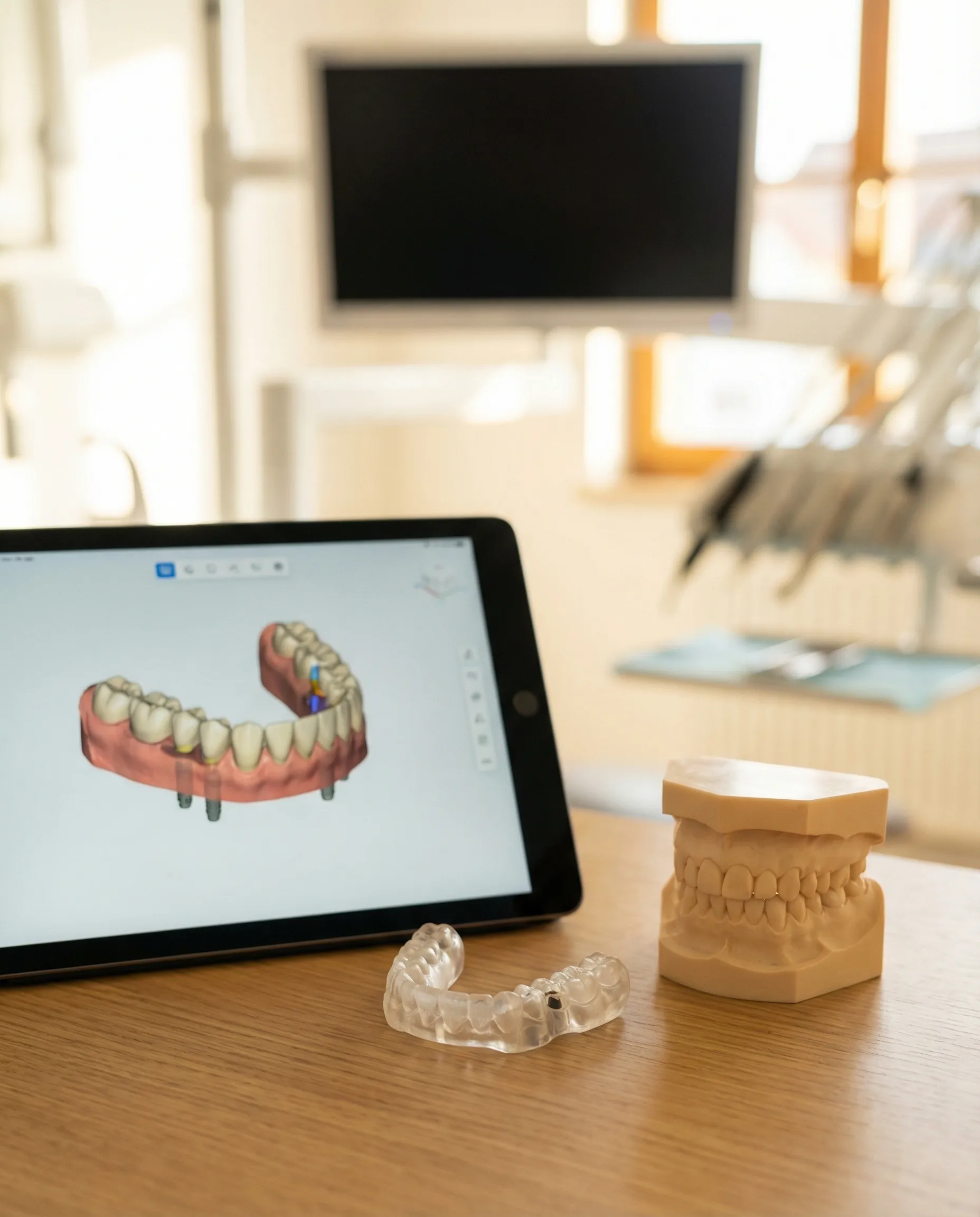
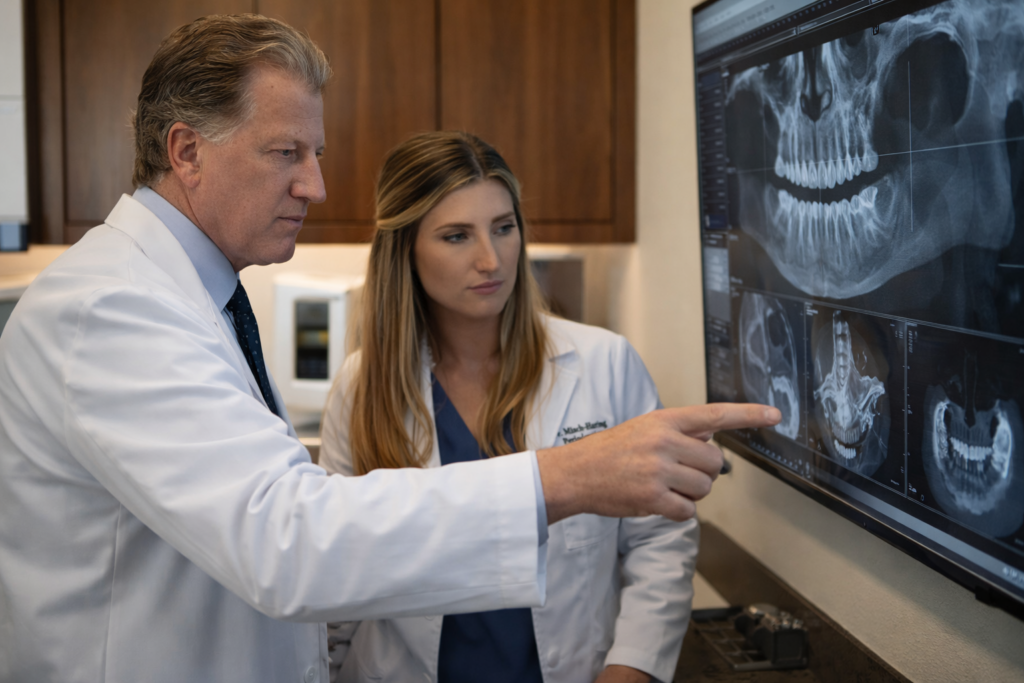
We use cone beam CT scanning, a three-dimensional X-ray that maps bone density, nerve location, sinus anatomy, and available bone thickness at every prospective implant site. Flat X-rays can look reassuring while concealing deficits that matter significantly when it’s time to place a 12-millimeter titanium post. CBCT is the planning tool that separates a predictable surgical outcome from an optimistic one, and it’s part of every All-on-4 consultation here.
Who Actually Qualifies for All-on-4 at This Practice
Patients Who Move Directly Into the Planning Phase
Strong candidates have enough bone volume at the planned implant sites, no active gum infection or untreated periodontal disease, and overall health that supports procedures under IV sedation. They've typically reached the point where preserving individual teeth no longer makes clinical or financial sense: severe decay, significant bone loss, failed prior restorative work, or years of missing teeth that have shifted adjacent structure. Age by itself is almost never the deciding variable. We treat patients in their 40s and patients in their 80s, and what usually determines the path forward is bone quality, not the calendar.
When Bone Grafting Opens the Door
If initial scans show insufficient bone volume to support stable implants at the required angles, bone grafting can restore what's missing. The grafting procedure and the All-on-4 placement are separated by a healing period, typically four to six months, so this route takes longer. Whether that pathway makes sense for your anatomy is a conversation that starts at your 3D imaging consultation. Some patients who've been told elsewhere they're not candidates qualify here once we've reviewed their full imaging data. The only way to know for certain is the scan.
Medical Conditions We Screen For Before Case Approval
Uncontrolled diabetes, active bleeding disorders, certain immunosuppressant medications, and bisphosphonate use for osteoporosis all affect implant planning and healing. None are automatic disqualifiers, but each one changes the surgical protocol, the healing timeline, and sometimes the choice of materials. Dr. Maggie reviews every case for these factors during the consultation. If there's something that changes the approach, you'll hear it directly rather than discover it partway through treatment.
What Happens During All-on-4 Surgery at Our Sarasota Office
The Planning Stage, Weeks Before Surgery Day
Once your CBCT scan is complete and your case is approved, we fabricate a 3D surgical guide using your scan data. The guide is a precision-printed stencil that fits over your gum tissue and shows the surgeon the exact position, angle, and depth for each implant, translating the digital plan into the surgical result without freehand approximation. Your provisional arch is fabricated in advance too, which is how same-day attachment becomes possible rather than requiring a separate manufacturing step on the day itself.
The Morning of Surgery
You arrive at our Tuttle Avenue office having followed the pre-surgical instructions about eating and medications. IV sedation is administered, and within minutes you’re in a relaxed, semi-conscious state for the duration of the procedure. Dr. Maggie handles any remaining extractions, places the implants at the planned positions and angles, and closes the surgical sites. For a full arch, the surgical portion typically runs two to two and a half hours. Most patients describe the experience as considerably less than they anticipated, though the sedation is doing most of that work.
From Implants to Attached Teeth in the Same Appointment
Once Dr. Maggie is satisfied with placement, the provisional arch is attached. You spend about an hour in recovery before being discharged with written post-operative instructions and a direct line to reach us if anything feels outside normal parameters. Because this is IV sedation rather than general anesthesia with intubation, recovery from the sedation itself is usually straightforward. You go home with a fixed set of teeth. Soft food that evening is fine.
Recovery After All-on-4: What the First Few Months Actually Look Like
The First Seven Days
Swelling peaks around day two or three. Most patients manage discomfort with the prescription provided, and the majority describe the first week as more manageable than they expected. Soft diet applies for the first several days: nothing hard, crunchy, or chewy that would stress the implant sites. Speech may feel slightly different initially as your tongue adapts to the shape of the provisional. That adjustment typically happens within a week or two without much effort on your part.
Weeks Two Through Eight
As swelling recedes, chewing function returns progressively. The soft diet loosens gradually, and by week four most patients are eating a reasonably broad range of foods, with the exception of anything requiring significant bite force through the front teeth. We schedule follow-up appointments at one week, four weeks, and eight weeks so the healing process is monitored throughout. If anything seems off between visits, you can reach us directly.
When Your Final Arch Is Ready
Three to six months after surgery, once updated imaging confirms osseointegration is complete, your final zirconia arch is fabricated and seated. Zirconia is harder than acrylic, more resistant to staining, and feels closer to natural enamel in surface texture. The placement appointment is brief: the provisional comes off, the permanent arch is seated, bite is verified, and you leave. With proper maintenance, the implants underneath should hold for a lifetime. The zirconia arch itself typically lasts 15 to 25 years before replacement is needed.
What All-on-4 Costs at Misch, and What's Included in That Number
The Per-Arch Investment at This Practice
Full arch restoration at Misch ranges from $25,000 to $35,000 per arch, depending on case complexity: number of implants, extent of any extractions, bone conditions discovered during planning, and the prosthetic material selected. Patients restoring both arches typically invest between $50,000 and $65,000 total. These figures cover the CBCT scan and surgical guide fabrication, IV anesthesia, surgery, the provisional prosthetic, all monitored follow-up appointments through osseointegration, and the permanent final arch.
Why the Investment Reflects What Actually Goes Into the Case
Every case involves two specialist-level clinicians working in coordinated sequence: a board-certified periodontist performing the surgery and a prosthodontist who designed the final prosthetic before the first implant was placed. That coordinated planning model, where the surgical and restorative disciplines align before rather than after surgery, is not universal. At practices where those two functions are handled by separate offices and providers who’ve never met before your treatment plan was built, the coordination gap shows up in the outcome, not just in the price comparison.
How Full Arch Compares Financially to Replacing Teeth Individually
Replacing a full arch with individual implants, assuming nine to twelve teeth require replacement, typically runs $5,000 to $6,000 per tooth for the implant, abutment, and crown. At the lower end, that’s $45,000 for nine implants. Full arch restoration consolidates that into a single surgical session with a single prosthetic structure. The comparison to traditional dentures is less about upfront cost and more about the true 10-year figure, factoring in relines, adhesives, repairs, and eventual full replacement as the underlying bone continues to shrink without implant stimulation.
Why Patients From Across Florida Choose This Practice for Full Arch Restoration
The Surgeon's Published Research Is on the Shelf in Implant Practices Worldwide
Dr. Maggie Misch-Haring performs all implant surgeries and bone grafting procedures at this practice. She’s a board-certified periodontist and co-author on peer-reviewed publications on bone augmentation: the same research that shapes how implant surgeons approach complex bone cases today. Her father-in-law, Dr. Craig Misch, authored the clinical textbooks that oral surgeons and implantologists worldwide use as standard references. The knowledge base informing your surgery comes from people who helped produce it, not from a training certification and a sales manual.
Your Prosthodontist Designs the Final Teeth Before Surgery Day Begins
Dr. Harry Haring, a prosthodontic specialist, designs the final arch before surgery begins, working from your scan data and your consultation notes about aesthetics, bite mechanics, and facial proportions. Dr. Maggie then places the implants at positions and angles that work with that design. At many practices, implants are placed first and the prosthodontist accommodates whatever angles and positions result. Working in the reverse order produces a more predictable outcome, both structurally and aesthetically.
The Same Family of Doctors, Start to Finish
Misch is a family practice in the most literal sense. Dr. Craig Misch, Dr. Katherine Misch, Dr. Maggie Misch-Haring, and Dr. Harry Haring are a family of specialists who practice in the same building and plan cases together in the same room. Your surgical doctor and your restorative doctor know each other, speak to each other before they speak to you, and will know your case when you walk in for any follow-up appointment two years from now. Patients who’ve come from large group practices or corporate chains consistently name this continuity as the part that surprised them most.
All-on-4 vs. Traditional Dentures: What the Real Comparison Looks Like
| Feature | All-on-4 Implants | Traditional Dentures |
|---|---|---|
| Fixed or removable | Fixed, doesn't come out | Removable |
| Bone preservation | Yes, implants stimulate bone | No, bone continues to shrink |
| Speaking | Normal immediately | Adjustment period; possible slip |
| Eating | Full chewing after healing | Limited to softer foods long-term |
| Daily maintenance | Brush like natural teeth | Soaking and adhesive required |
| Lifespan | 15-25 yrs (arch), lifetime (implants) | 5-10 yrs before replacement |
| Upfront cost | $25,000-$35,000 per arch | $1,500-$4,000 per arch |
| 10-year true cost | Lower, no replacement cycle | Higher with relines and replacement |
Why Patients Who Try Dentures First Often Return for Implants
Dentures fit well in year one. The problem is that once teeth are gone, the bone beneath them shrinks without stimulation from roots or implants, so a denture that fits today will feel loose by year three and require a reline. By year seven or eight, most full dentures need full replacement. Patients using adhesive daily and returning for repeated relines sometimes realize, a few thousand dollars and several years in, that the long-term math was never clearly in the denture’s favor. The American Academy of Periodontology has documented the relationship between tooth loss, bone resorption, and long-term oral health outcomes. When they eventually come here, what most of them say is that they wish they’d had this conversation earlier.
All-on-4 Dental Implants: Questions We Hear at Nearly Every Consultation
How long does All-on-4 surgery take?
The surgical portion runs two to two and a half hours per arch. After that, you spend roughly an hour in recovery before going home. Plan for a full day: the sedation alone warrants it, and you’ll want time to rest. We schedule these procedures with enough buffer that nothing feels rushed on the surgical end.
Will I actually have teeth when I leave the office?
Yes. The provisional arch is attached to the implants the same day. You leave with a fixed set of teeth that functions well enough for soft foods immediately. It’s not the final arch, which comes three to six months later once osseointegration is confirmed, but most patients stop treating it as temporary fairly quickly because it looks and functions well enough to live normally with.
I've been told I don't have enough bone. Does that rule me out?
Not necessarily. The All-on-4 technique was specifically developed to work with reduced bone volume, using angled posterior implants that reach denser bone that vertical placement can’t access. Beyond that, bone grafting can restore volume in many cases where the deficit is significant. Some patients who’ve been declined elsewhere qualify here once we’ve reviewed full 3D imaging rather than a flat X-ray. A definitive answer starts with the CBCT scan.
How painful is the recovery?
The procedure itself isn’t something most patients experience in any meaningful way: the IV sedation handles that. The recovery involves swelling that peaks around day two or three, and discomfort that’s typically manageable with the prescription provided. Most patients describe the first week as easier than they expected. That said, everyone’s baseline is different, and you’ll have a direct contact number at this office for anything that feels outside normal parameters.
Does Misch accept dental insurance for All-on-4?
This practice is fee-for-service and doesn’t participate in insurance networks directly. Some patients submit to their own plan for partial reimbursement as an out-of-network service, which works with certain plans. We can provide the documentation needed for that submission. Financing options are also available for patients who prefer to spread the investment over time, and the treatment coordinator will walk through both during your consultation.
How long do the implants actually last?
Titanium implants are designed to integrate with bone and, with consistent oral hygiene and regular hygiene visits, remain in place for a lifetime. The final zirconia arch typically lasts 15 to 25 years, per the American Academy of Prosthodontics. At that point, the implants stay in place and only the prosthetic is replaced.
Can both arches be done in the same surgical session?
Yes, and many patients choose this. Doing both at once means a single recovery period rather than two, and the surgical planning for both arches happens together, which allows the upper and lower prosthetics to be designed in relation to each other from the start. Whether it’s the right approach for your case depends on anatomy, overall health, and factors Dr. Maggie reviews before making that recommendation.
Ready to Find Out Whether All-on-4 Is Right for You?
The consultation includes a CBCT scan review, a clinical evaluation by Dr. Maggie, and a conversation about what your final teeth can look like. You leave with a clear picture of whether you’re a candidate, what the process involves, and what it costs for your specific case. If you qualify, we’ll tell you directly. If something changes the recommendation, we’ll tell you that too.
Call us at (941) 957-6444
Monday through Thursday, 8 AM to 4 PM | Friday, 8 AM to 12 PM
120 South Tuttle Avenue, Sarasota, FL 34237