
Signs You May Need Full Mouth Rehabilitation
By Dr. Harry Haring, DMD | Prosthodontist
Published: September 2026
Most people do not arrive at this question all at once. It builds: a crown that comes off for the second time, a molar that cracks while you are eating something soft, front teeth that look shorter in photographs than they used to, a bite that feels slightly off in a way you cannot describe to anyone. Each problem gets treated on its own, and each fix holds for a while, and then something else goes. The signs you need full mouth rehabilitation rather than another single repair are usually already there by then, and they are easier to recognize once you know what they are reporting.
Below are four of them, explained at the level of what is physically happening rather than just what it looks like, along with an honest section on when a single fix really is the right answer. That last part matters. Plenty of people are told they need everything rebuilt when they do not.
When Single Fixes Stop Holding
The Pattern Most Patients Describe
The story is remarkably consistent. Someone has had good dentistry done over twenty or thirty years, a crown here, a bridge there, a root canal at some point, and none of it was wrong at the time. Then the interval between problems starts shortening. What used to be one repair every few years becomes two in eighteen months, and the second replacement of the same crown fails faster than the first did. That shortening interval is the signal, more than any single failure is, because it means the thing causing the failures was never part of the treatment.
Reconstruction Versus a Series of Repairs
Full mouth rehabilitation is a plan built around the whole mouth at once: how the upper and lower teeth meet, how much vertical height the bite has left, where the bone can support an implant and where it cannot, and in what order the work has to happen so that each step supports the next. A series of repairs treats whatever hurts most this month. Both are legitimate, and the first one exists because for some mouths the second one has stopped working, which is what the signs below are really telling you.
Four Signs Worth Taking Seriously
These four come up more than any others in complex cases, and they are the four where the mechanism is worth understanding, because understanding it is what makes the treatment recommendation make sense instead of sounding excessive. Nobody has all four. Two together is common, and two together is usually where the signs you need full mouth rehabilitation start to outweigh the case for another individual repair.
Your Teeth Are Getting Shorter
Enamel wears at a rate the jaw can compensate for, and for most of a lifetime it does, quietly. Grinding and clenching accelerate it, sometimes dramatically, and so does acid reflux and a diet heavy in acidic food and drink. What eventually happens is that enough height is lost across enough teeth that the jaw closes further than it was built to close, and the muscles learn that new shorter position as normal. Dentists call the measurement that is being lost the vertical dimension of occlusion, and losing it changes more than the look of your smile: the lower face shortens, the chin comes forward slightly, the corners of the mouth deepen, and the front teeth start absorbing force that the back teeth used to carry.
The reason this one matters so much for treatment planning is that a single crown cannot be built to the right height inside a collapsed bite. There is nowhere for it to go. Restore one worn molar to its original dimension and it becomes the only tooth touching, which is why it chips or debonds within a year and why the patient is told the crown “failed.” Restoring lost height is a whole-arch decision, made once, with the joint and the muscles accounted for, and it is the single most common reason a case gets planned comprehensively.
If it is left alone, wear accelerates rather than plateaus, because each millimeter of lost height concentrates more force on fewer teeth. Teeth that have already lost a lot of structure eventually fracture rather than wear, and a fracture that runs below the gum line turns a restorable tooth into an extraction, which changes what the treatment plan can offer.
The Same Crown Keeps Failing
A crown that comes off once is usually a cement or a preparation issue and the fix is straightforward. A crown that comes off twice, or a bridge that fractures in the same place a second time, is reporting something different: the restoration is being asked to absorb more force than that tooth in that position can carry. Replacing it in better material buys time without changing the load, which is why the third one tends to last less time than the second did.
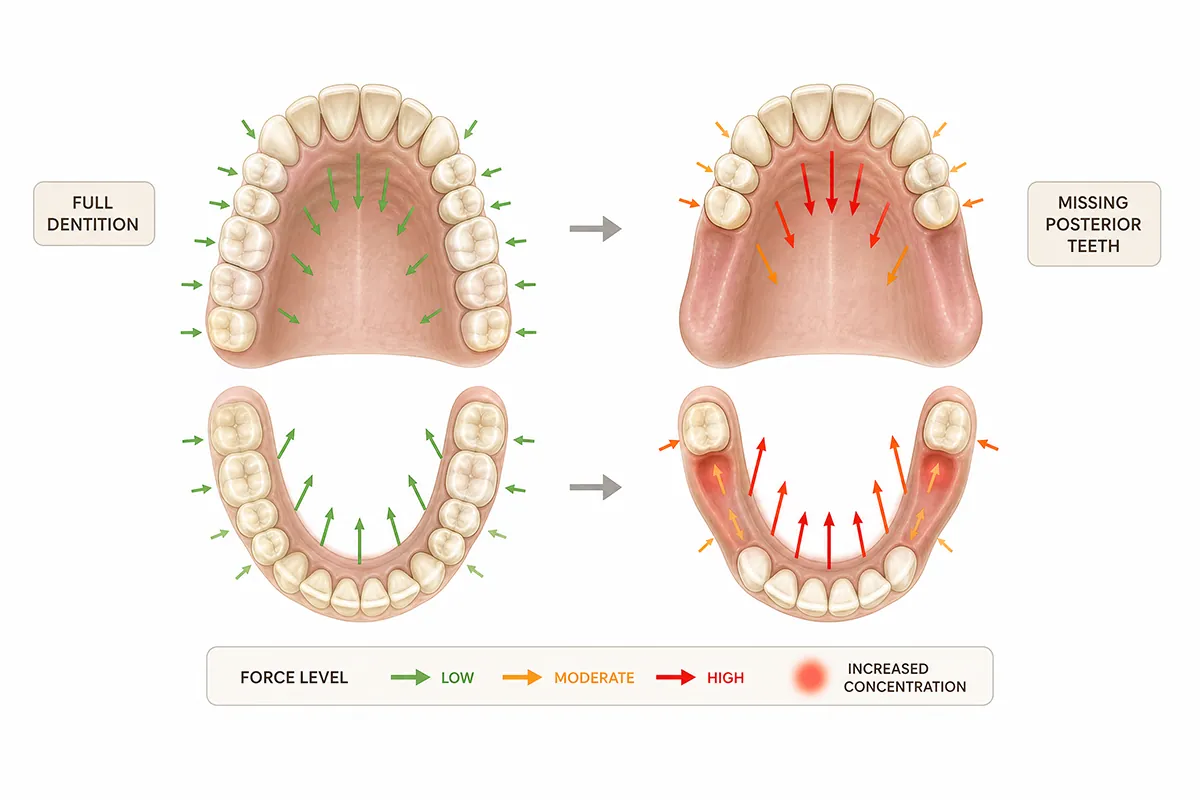
Where the extra force comes from is usually mapped out easily once someone looks at the whole mouth. A missing molar on the opposite side means you chew almost entirely on the restored side. A missing tooth in the lower arch means the upper tooth above it has nothing to meet and slowly over-erupts, so the two arches no longer share load the way they were shaped to. Add lost vertical height and you can end up with two or three teeth doing the work of eight. Those teeth carry crowns, so those crowns are what fail, and the pattern of which restorations keep breaking is often the clearest map of where the bite has gone wrong.
This is the sign that brings the most second opinions through our door, usually from someone who has been quoted a fourth replacement of the same crown and has started to wonder whether anybody is looking at the larger picture. Frequently the honest answer is that the crown was never the problem.
Teeth Are Drifting, Tipping, or Feeling Loose
Bone responds to load. Where a tooth is present and functioning, the bone that holds it stays dense; where a tooth has been gone for years, the ridge narrows and loses height, and it keeps doing so gradually rather than stabilizing. That is why a gap that has been there a long time is a different treatment problem from a recent one, and why grafting sometimes becomes part of a plan that would not have needed it earlier.
Movement is the visible version of the same story. Neighbors tip into an old space, the opposing tooth drops down into it, and contacts open up between teeth that used to sit tightly together, so food starts catching in places it never did. Advanced periodontal disease adds a second mechanism: it removes the bone support around teeth that still look completely normal above the gum line, which is how a tooth that has never hurt can start to feel slightly mobile. Loose teeth in an adult are always worth an evaluation, and they are one of the few signs on this list that should not wait for a convenient time.
Left alone, the practical consequence is not dramatic; it is that the eventual plan gets bigger. More lost bone means more grafting, longer healing between phases, and fewer positions where an implant can go exactly where the tooth used to be.
Your Jaw Aches and Your Teeth Are Wearing
Jaw joint and muscle symptoms show up for many reasons and most of them have nothing to do with reconstruction. What is worth attention is the combination: morning jaw soreness or temple headaches arriving alongside visible wear, chipped edges, and a bite that has changed. Together those usually describe one problem rather than two, since the muscles are compensating for a bite that no longer distributes force evenly, and the teeth are showing the wear that compensation produces.
The planning consequence is specific. Rebuild the teeth without accounting for where the joint and the muscles actually want the jaw to close, and you get a result that looks correct and comes apart, because the same forces are still there. Cases with a joint component get evaluated and often stabilized before any final restoration is made, which is a real reason some plans take longer than patients expect.
Why These Signs Travel Together
Your Bite Is One Connected System
Reading the four signs above as a checklist misses what they have in common. Lost height concentrates force, concentrated force breaks restorations, broken and missing teeth shift load onto whatever is left, shifted load pulls the muscles and the joint into compensating, and compensation wears the remaining teeth down further. Each sign is a consequence of the ones around it, which is why they arrive as a group and why treating any one of them alone tends to buy a couple of years rather than fix anything. The signs you need full mouth rehabilitation are really one finding described from four angles.
What a Comprehensive Plan Is Actually Solving
Sequence, mostly. In a mouth like this the order of operations decides the outcome: gum disease has to be controlled before implants go anywhere near it, grafted bone needs months before it can hold a fixture, the final bite height has to be tested in temporary teeth and lived in before anything permanent is made, and the surgeon and the restorative doctor have to agree on where each implant goes before the first one is placed. A comprehensive plan is what holds that sequence together. Our own full mouth rehabilitation page walks through how that sequencing runs phase by phase, including how long each phase realistically takes.
Why Waiting Changes the Plan Rather Than Delays It
Waiting is a reasonable choice and many patients make it for good reasons. What is worth knowing before you choose it is that the treatment on offer changes while you wait, since bone that is lost does not come back on its own and a fractured root cannot be crowned. A case that needs three implants and no grafting this year can need five implants and two grafts in four years, and that is a different plan with a different timeline. Nothing about that is a reason to rush a decision this large, and it is worth knowing which version of the plan you are choosing between.
When a Single Fix Is Genuinely Enough
Not every complicated-sounding dental problem needs a comprehensive plan, and a fair number of people who are told they do are being over-treated. The signs you need full mouth rehabilitation are fairly specific, so three situations that resemble them without qualifying are worth naming.
One Failing Tooth in an Otherwise Stable Mouth
A single cracked or heavily decayed tooth, where the rest of the arch is intact, the bite height is normal, and nothing else has needed work in years, is a single-tooth problem. It gets treated as one: a crown, or an extraction and an implant, and that is the whole plan. The presence of one significant problem is not evidence of a whole-mouth one.
A Cosmetic Concern Sitting on a Healthy Bite
Wanting straighter, brighter, or better-shaped front teeth is a cosmetic question, and when the bite underneath is sound it stays a cosmetic question. Veneers and bonding are the right answer there and reconstruction is not. The distinction is whether the teeth are unattractive or whether they are also failing, and that is a clinical finding rather than a judgment call the patient has to make alone.
Gum Disease Caught Before It Costs Bone
Periodontal disease treated at the stage where bone loss is minimal is a periodontal problem with a periodontal solution, usually scaling and root planing plus a maintenance schedule, and it does not become a reconstruction case. That is the strongest argument for having a mouth looked at early: most of what makes these cases complex is time, not the original problem.
Your First Visit, Start to Finish
What We Look At
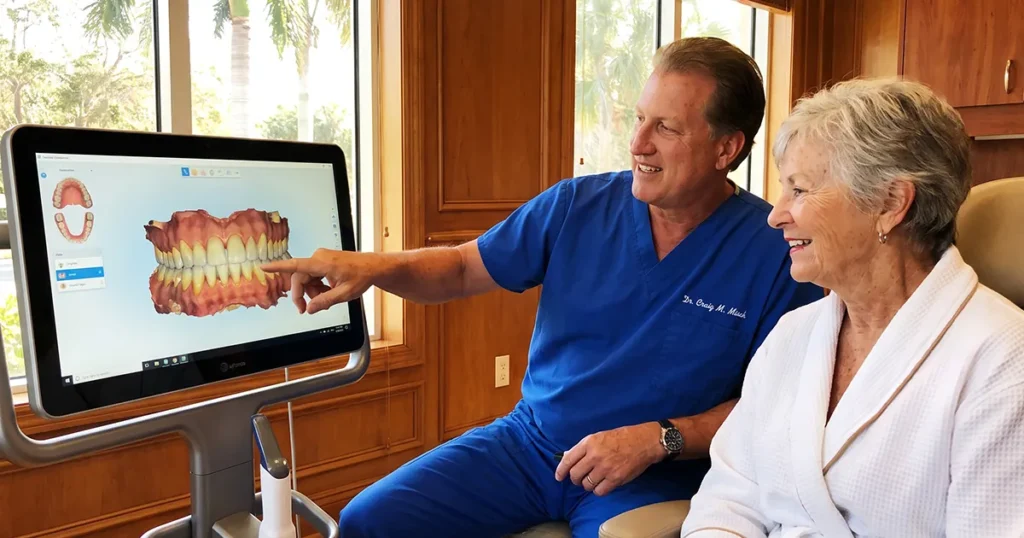
A comprehensive evaluation for a case like this takes about ninety minutes and produces the records that any real plan has to be built on: a 3D CBCT scan showing bone volume and the joints, a digital scan of both arches, photographs, a full periodontal charting, and a bite analysis that measures how much vertical height has actually been lost. Those records are what turn “you probably need a lot of work” into a specific list of what needs doing and in what order.
What You Leave With
You leave knowing which of the four signs above apply to you, what the underlying cause is, what the options are including the option of doing less, and roughly what each option involves in time and cost. Second opinions are a normal part of what we do and we are comfortable telling someone that the plan they were given elsewhere is sound, or that a smaller version of it would serve them better.
What It Costs
What Moves the Number
Four things account for most of the variation between one case and another: how many teeth are missing or unrestorable, whether grafting is needed before implants can be placed, whether the bite height has to be rebuilt across both arches or only one, and whether the joint needs stabilizing first. A case with intact bone and eight teeth to restore and a case needing sinus lifts, ridge grafting, and a full-arch rebuild are both called full mouth rehabilitation and are not remotely the same undertaking. Nobody can price it responsibly before the records exist, which is why the evaluation comes first.
Where the Range Sits
Full mouth rehabilitation is a significant investment, typically ranging from $30,000 to $80,000 or more depending on complexity and extent, and our full mouth rehabilitation page breaks that down by treatment phase so you can see which parts of the total belong to which stage of work. Our practice is fee-for-service and does not participate in insurance networks, which is part of how the same family of specialists stays involved in a case from the surgery through to the final teeth.
Our Family Plans These Cases Together
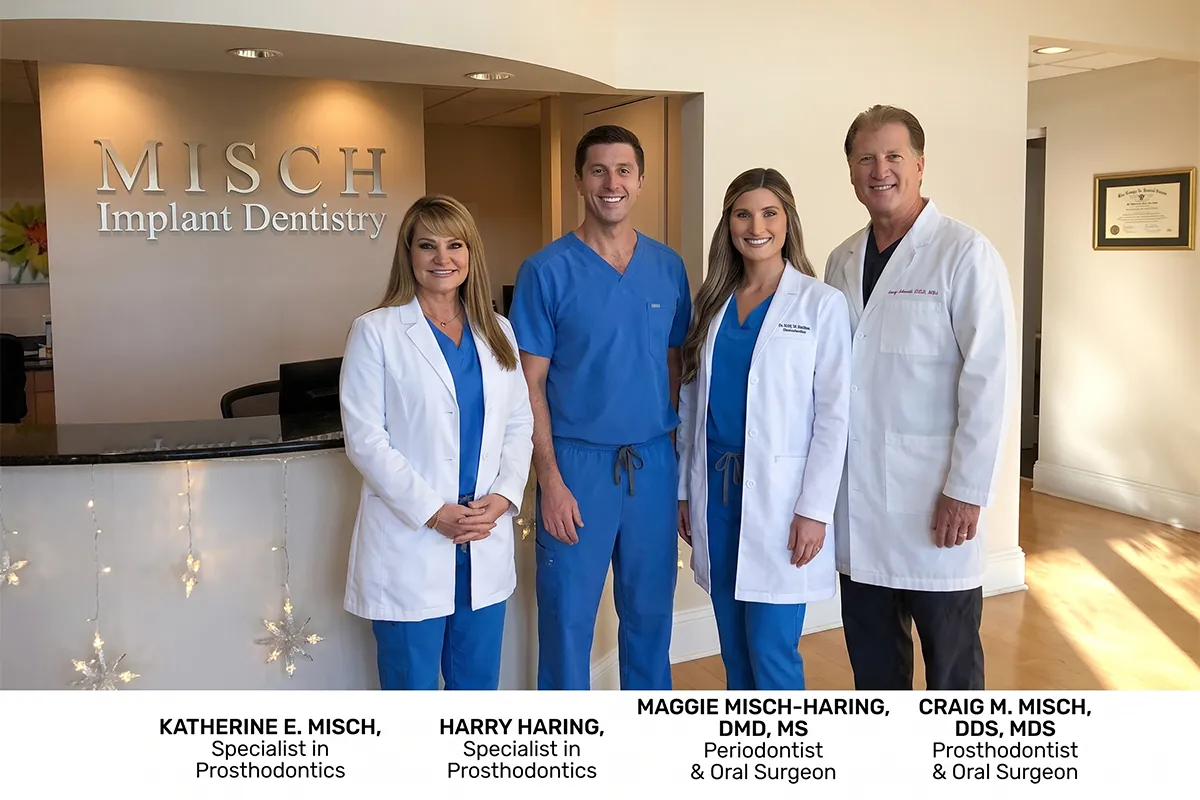
Complex reconstruction goes wrong most often at the handoffs, when the surgeon placing implants and the doctor making the final teeth are in different offices making decisions separately. At our practice they are in the same room. Dr. Craig M. Misch is a board-certified oral surgeon and board-certified implantologist who has written textbooks on bone augmentation for implant therapy and lectures internationally on it. Dr. Maggie Misch-Haring is a board-certified periodontist and performs the implant surgery, bone grafting, and gum grafting. Dr. Katherine E. Misch and Dr. Harry Haring are prosthodontists and handle the restorative side, the crowns, bridges, and final prosthetic teeth that the whole plan is built toward.
Practically, that means the bite height gets decided by the person who will restore it, in conversation with the person who will place the implants, before either commits to anything. It also means the same family of doctors sees you through the surgery, the temporary teeth, the final restorations, and the maintenance visits for years afterward, which on a case that runs a year or more is the difference between a plan and a series of appointments. Our hygienist keeps that long-term maintenance in-house too, so nobody hands you off once the reconstruction is finished.
Common Questions About Full Mouth Rehabilitation
What are the signs you need full mouth rehabilitation rather than single-tooth treatment?
The clearest ones are teeth that have visibly lost height across the arch, restorations that keep failing in the same places, teeth drifting or feeling loose, and jaw or muscle symptoms arriving alongside that wear. What distinguishes a whole-mouth problem from a series of unrelated ones is that the interval between problems keeps shortening, and that each repair holds for less time than the one before it. An evaluation with 3D imaging and a bite analysis is what settles it.
Can I just keep replacing the crowns that fail?
You can, and for some patients that is the right trade-off, particularly when age, health, or circumstances make a year-long treatment plan unattractive. What is worth going in knowing is that each replacement tends to last less time than the last, because the force causing the failures has not changed, and that a tooth eventually fractures rather than losing a crown. When the fracture runs below the gum line, the tooth comes out, so the choice is usually between rebuilding on your schedule and rebuilding on the mouth’s.
How is this different from All-on-4?
All-on-4 replaces a full arch of missing or unsalvageable teeth with a fixed bridge on four implants. Full mouth rehabilitation keeps and restores whatever natural teeth are worth keeping and rebuilds the rest around them, so it is the option for a mouth that still has viable teeth in it. Our full mouth rehabilitation page compares the two in detail.
Will I have to have all my teeth taken out?
No, and preserving teeth that are worth preserving is a large part of the planning. Extraction is recommended for teeth that cannot be restored predictably, not as a shortcut to a simpler plan.
How much does full mouth rehabilitation cost?
It typically ranges from $30,000 to $80,000 or more, depending on how many teeth need restoring, whether grafting is required first, and whether the bite has to be rebuilt across one arch or both. The evaluation is what produces a real figure, broken out by phase, and our service page shows how that breakdown is structured. We are fee-for-service and do not participate in insurance networks.
Do you see patients who were diagnosed somewhere else?
Regularly, and it is one of the more common reasons people come in. Sometimes we confirm the plan they were given, sometimes we find that a smaller amount of work would serve them just as well, and occasionally we find that something significant was missed. You are welcome to bring your existing records, imaging, and treatment estimate with you.
How long does the whole process take?
Most cases run nine months to two years, driven mainly by healing time between phases rather than by chair time. The phase-by-phase timeline is on our full mouth rehabilitation page.
Find Out Which of These Applies to You
If two or three of the signs you need full mouth rehabilitation sound like your mouth, the useful next step is a comprehensive evaluation that tells you what is actually driving them and what your options are, including the smaller options. Bring whatever records and estimates you already have. We will give you a straight answer about your own case, even when that answer is that you need less than you were told.
Or call our Sarasota office at (941) 957-6444.