
Sarasota’s Full Arch Restoration specialists
All-on-4 Full Arch Restoration: A Complete Smile in One Day
You have tried everything: the dentures that slip every time you laugh, the bridge that failed after eight years, or the partial that makes eating a steak a real challenge. Or perhaps you have spent years pouring tens of thousands of dollars into root canals, crowns, and extractions, only to watch one tooth after another fail. At some point, the math stops making sense and you ask yourself if there is a better way.
The answer is yes. It is called full arch restoration, and it is the procedure that allows patients to stop hiding their smiles and start showing them off with pride. In a single day, we remove any failing teeth, place four to six strategically positioned implants, and attach a prosthetic arch that looks and functions like natural teeth. You walk in with a mouth full of problems and walk out with a beautiful smile you haven’t had in decades.
Best of all, this is not a removable denture that comes out at night or requires adhesives. It is permanently anchored to your jawbone and designed to last. For patients who have struggled with dental issues their entire adult lives, a full arch restoration is a complete fresh start.
What Is All-on-4 Full Arch Restoration?
If you are facing the loss of multiple teeth or already wear dentures, All-on-4 offers a permanent and stable alternative. Let us explain the technique behind this transformation.
The Concept: Four Implants, One Complete Arch
The name "All-on-4" refers to the technique: an entire arch of teeth, typically ten to fourteen prosthetic teeth, supported by just four dental implants. Two implants are placed vertically in the front of the jaw, where the bone is naturally thickest, and two more are placed at angles in the back, allowing them to anchor into denser bone while avoiding the sinus cavities in the upper jaw or the nerve canal in the lower jaw.
This angulation is what makes All-on-4 different from traditional implant approaches. Instead of placing six, eight, or even ten implants per arch, where each requires adequate bone height and density, we use strategic positioning to maximize the bone you already have. For many patients, this means full arch restoration is possible without extensive bone grafting, reducing both the cost and the treatment timeline.
All-on-4 vs. All-on-6: When More Implants Make Sense
While four implants are sufficient for most patients, some cases benefit from six implants per arch. We recommend All-on-6 when:
The jaw is longer than average and requires additional support in the middle of the arch. The patient has a history of bruxism or teeth grinding, which places extra stress on the prosthetic. The bone quality is slightly compromised and distributing force across more implants improves long-term stability.
The decision between four and six implants is about designing the right solution for your specific anatomy. During your consultation, Dr. Craig or Dr. Maggie will evaluate your CBCT scan and recommend the best approach.
Fixed vs. Removable: Why We Recommend Fixed Prosthetics
Some practices offer "implant-supported dentures" or "snap-on dentures," which are removable prosthetics that snap onto two or four implants. While this is better than a conventional denture, it is not the same as a fixed full arch restoration.
A fixed prosthetic is screwed directly onto the implants and does not move, meaning it does not make noise when you speak. You brush it like natural teeth and never take it out, as the only person who removes it is your dentist during periodic maintenance appointments.
We believe that if you are going to invest in implants, you deserve the best possible outcome, and that is why we primarily recommend fixed full arch restorations. If budget is a concern, we discuss all your options honestly, but we do not push you toward an inferior solution just to close a sale.
The All-on-4 Procedure: What Happens on Surgery Day
All-on-4 is the solution that changed the game for patients who have lost most or all teeth in an arch. Here is how it works and why it is so effective.
Before Surgery: Planning Your New Smile
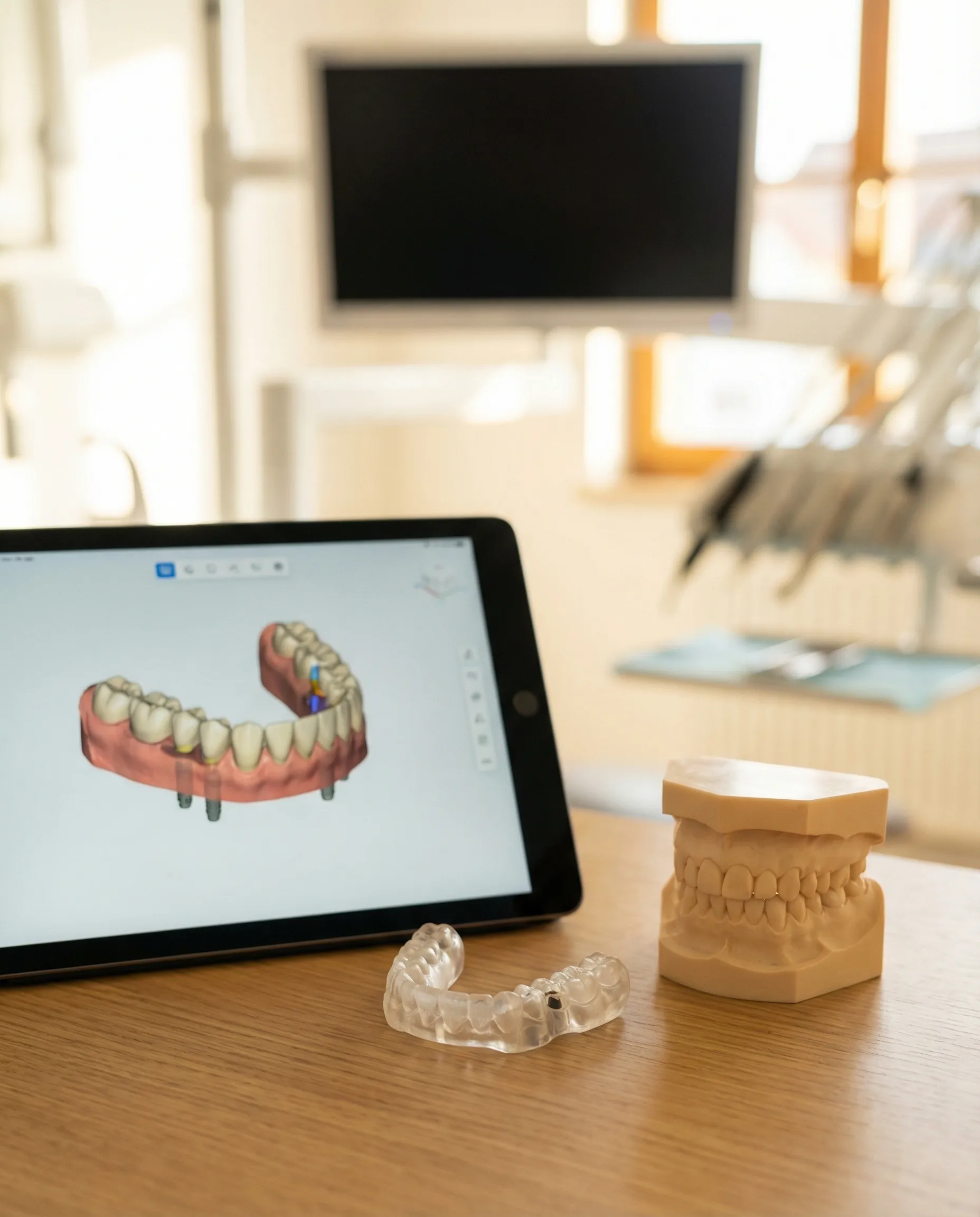
Every full arch case begins weeks before surgery. We take a CBCT scan, a three-dimensional X-ray that shows your bone density, nerve locations, and sinus anatomy in precise detail. Furthermore, we also take digital impressions and photographs of your current teeth (or gums, if you are already missing teeth).
Using this data, we design your new smile digitally, and this way, you will see how your final teeth will look even before we start surgery. If you want them whiter, longer, or with a different shape, we adjust the design, using a custom-fabricated prosthetic to complement your face, your lip line, and your preferences.
We also create a surgical guide, a 3D-printed stencil that ensures each implant is placed at the exact angle and depth planned in the digital model. There is no guesswork during surgery because the guide fits onto your jaw and the drill follows the pre-planned path.
Surgery Day: Extractions, Implants, and Temporary Teeth
On the morning of surgery, you will arrive at our Sarasota office and receive IV sedation. Our patients are kept comfortable throughout the procedure, remaining relaxed and responsive while experiencing little to no memory of the surgery afterward."
While you are sedated, we extract any remaining failing teeth, place the four to six implants per arch, and attach a fixed temporary prosthetic. This temporary bridge is designed to be worn during the healing period (typically four to six months). Most importantly, this bridge is functional, allowing you to eat soft foods immediately, but it is not your final restoration.
The entire surgery typically takes two to three hours per arch. After the surgical procedure, the patient spends an additional hour in recovery before a family member or friend drives them home.
The Healing Period: What to Expect
In the first week, the patient may experience swelling, bruising, and some discomfort. Therefore, we prescribe pain medication, antibiotics, and an anti-inflammatory rinse, and most patients manage well with over-the-counter ibuprofen after the first few days.
During the healing period, you will maintain a light and soft diet, avoiding anything that requires significant chewing force. Think scrambled eggs, yogurt, pasta, fish, and steamed vegetables, which protects the implants while osseointegration occurs, the process by which your bone grows around and bonds to the titanium posts.
Once done, you will return for follow-up appointments at one week, one month, and three months after surgery. We check your healing, adjust the temporary prosthetic if necessary, and answer any questions that may arise.
Are You a Candidate for Full Arch Restoration?
Full arch restoration works for a wide variety of patients, even those who have been told they do not have enough bone. Let’s see if you qualify:
Ideal Candidates
Full arch restoration is designed for patients who have lost most or all of their teeth in one or both arches, have multiple failing teeth that are not worth saving individually, are currently wearing dentures and hate them, or have been told they need a "full mouth reconstruction" and want a permanent solution.
You do not need perfect bone to be a candidate, as the angled implant technique allows us to work with the bone you have available. However, if your bone loss is severe, we may recommend a preliminary grafting procedure or an alternative approach like zygomatic implants (which anchor into the cheekbone instead of the jaw).
Learn more about bone grafting →
Who Is NOT a Candidate
In rare cases the bone graft may not integrate properly, which can result from infection, smoking, membrane perforation or simply unpredictable healing. If a graft fails, we remove the material, allow the site to heal and typically attempt a second graft with a modified approach, and most patients who experience initial failure go on to successful grafting.
Medical Considerations
Certain conditions require extra planning but do not automatically disqualify you:
- Diabetes: If your blood sugar is well-controlled (A1C under 7), you can safely undergo implant surgery. Uncontrolled diabetes impairs healing and increases infection risk, so we will work with your physician to optimize your levels before surgery
- Osteoporosis: Bisphosphonate medications (like Fosamax or Boniva) can affect bone healing. If you have taken these medications, we evaluate the risk and may coordinate with your prescribing doctor.
- Smoking: Heavy smoking significantly increases implant failure rates. Therefore, we strongly encourage patients to quit, or at minimum, reduce to fewer than ten cigarettes per day before and after surgery.
- Blood thinners: Medications like Warfarin or Eliquis require coordination with your cardiologist. To ensure everything goes as smoothly as possible, we may ask you to temporarily adjust your dosage around the surgery date.
Full Arch Restoration Cost: What You Are Actually Paying For
Full arch restoration is a significant investment, and you deserve to know where every dollar goes. Here is the complete breakdown with no surprises:
The Investment Breakdown
Full arch restoration at our practice ranges from $25,000 to $35,000 per arch, depending on the complexity of your case and the materials used for your final prosthetic. This includes:
- All pre-operative imaging (CBCT scan, digital impressions, photographs).
- Surgical placement of four to six implants.
- Extraction of any remaining teeth.
- IV sedation for your comfort.
- The temporary fixed prosthetic worn during healing.
- All follow-up appointments during the healing period.
- The final zirconia or hybrid prosthetic.
- One year of post-operative maintenance visits.
For patients restoring both arches, the total investment is typically $50,000 to $65,000.
Why Full Arch Costs More Than Individual Implants
A single dental implant costs $4,000 to $6,000. So why does a full arch with just four implants cost $25,000 or more?
The answer lies in the prosthetic, as a single implant crown is one tooth. A full arch prosthetic is ten to fourteen teeth, custom-designed and milled from a solid block of zirconia or layered with ceramic for lifelike aesthetics.
The laboratory work alone can cost $8,000 to $12,000. Add to that the surgical complexity of placing multiple implants in a single session, the IV sedation, and the months of follow-up care, and the cost reflects the true scope of the procedure.
Comparing Costs: Full Arch vs. Individual Implants vs. Dentures
Let’s say you are missing all your upper teeth. Here are your options:
Conventional denture:
$2,000 to $4,000 upfront.
But you will need relines every two to three years ($300 to $500 each), new dentures every five to seven years, and you will continue losing bone, which makes each subsequent denture fit worse than the last. Over twenty years, you will spend $15,000 to $20,000 and still have a prosthetic that slips and limits what you can eat.
Implant-supported overdenture:
$15,000 to $20,000 for a removable denture that snaps onto two to four implants.
Better stability than a conventional denture, but it still comes out at night, requires periodic replacement of the attachment components, and does not prevent bone loss under the denture base.
Implant-supported overdenture:
$25,000 to $35,000 for a fixed prosthetic that never comes out, preserves your bone, and lasts twenty-five years or more.
When you calculate the cost per year, it is often the most economical choice, and it is certainly the best quality of life.
Insurance Information
Most dental insurance plans cover a portion of implant treatment, typically 50% of the “allowable” amount, up to an annual maximum of $1,500 to $2,500. For a $30,000 full arch case, insurance might contribute $1,500 to $2,000, which helps, but it will not cover the majority of the cost.
We are a fee-for-service practice, which means we do not participate in insurance networks. However, we provide all detailed documentation so you can submit claims to your insurance company for out-of-network reimbursement.
Why Patients Choose Misch for Full Arch Restoration
25+
Years of Clinical Excellence in Sarasota
The Surgeons Who Wrote the Textbook
Full arch restoration is only as good as the surgeon placing the implants. At Misch Implant & Aesthetic Dentistry, your surgery is performed by Dr. Craig M. Misch or Dr. Maggie Misch-Haring—both board-certified specialists with decades of combined experience in complex implant cases.
Dr. Craig literally wrote the textbook on bone grafting that oral surgeons worldwide use as their reference. He’s placed thousands of implants over a thirty-year career and has lectured internationally on advanced surgical techniques. Dr. Maggie, a board-certified Periodontist, performs all implant surgeries with expertise in both hard and soft tissue management—ensuring your implants have the healthiest possible foundation.
When you choose Misch, you’re not getting a general dentist who took a weekend course on implants. You’re getting the specialists who train other dentists.
Restorative Excellence: Prosthodontists Design Your Smile
Placing implants is only half the equation. The prosthetic—your actual teeth—determines how your smile looks and functions. That’s why your final restoration is designed by Dr. Katherine E. Misch or Dr. Harry Haring, both Prosthodontists who specialize in complex restorative cases.
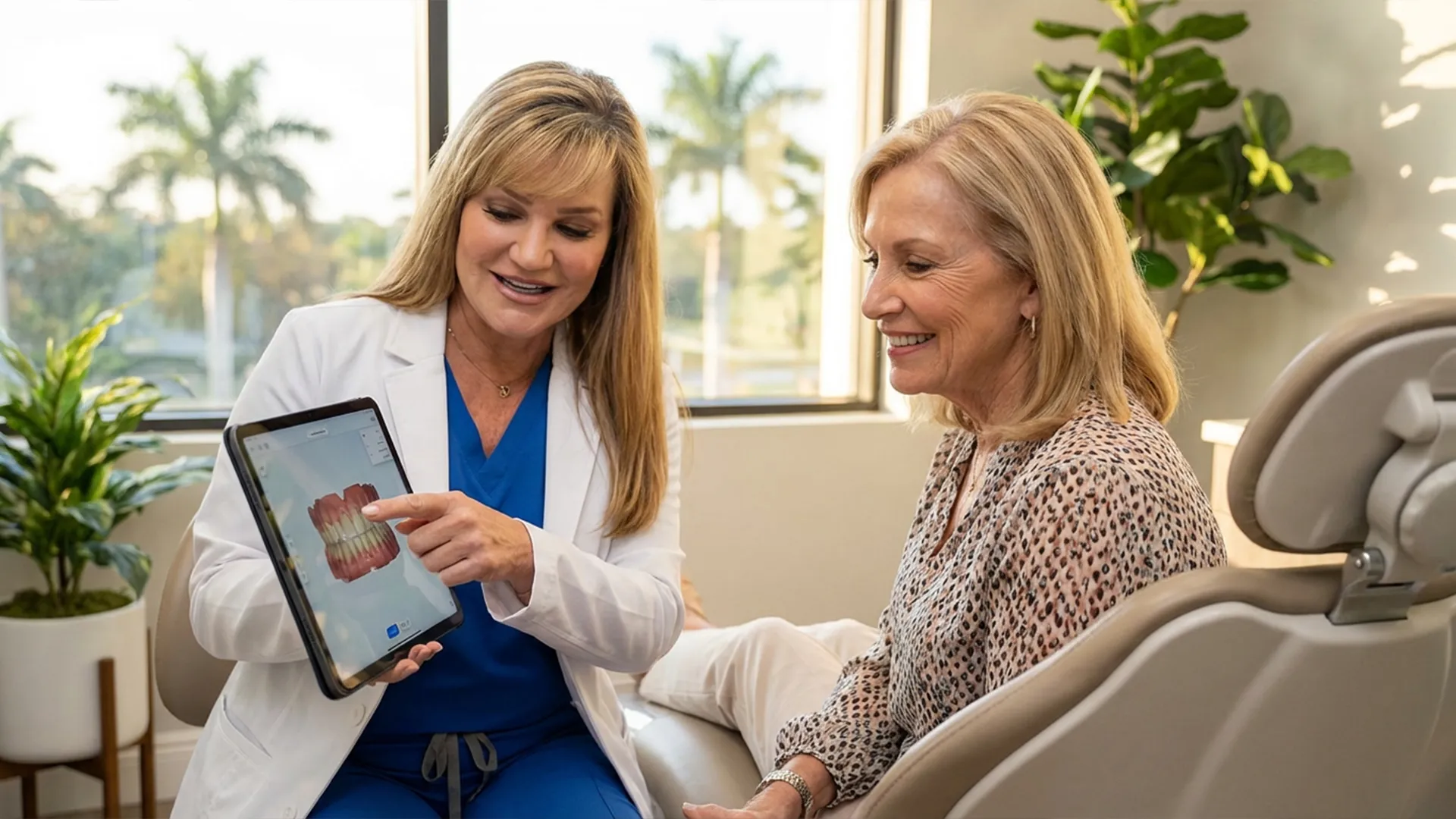
Dr. Harry has particular expertise in digital smile design for full arch cases. He uses advanced software to show you exactly what your new teeth will look like before surgery—and he works closely with our laboratory to ensure the final prosthetic matches the digital plan precisely.
Continuity of Care: The Same Family, Start to Finish
At corporate dental chains, you might see one doctor for your consultation, another for surgery, and a third for your final prosthetic. Each time, you’re explaining your history to someone new. Each time, there’s potential for miscommunication.
At Misch, your entire treatment is coordinated by one family of specialists. Dr. Craig or Dr. Maggie performs your surgery. Dr. Katherine or Dr. Harry designs your prosthetic. And Natalie Rosbury, RDH, our dental hygienist, manages your long-term maintenance. Everyone knows your case. Everyone is invested in your outcome. That’s what continuity of care looks like.
Full Arch Restoration FAQs
We know you have questions, and we want to answer them before you even ask. Here are the most common inquiries we receive regarding full arch restoration.
How long does the All-on-4 procedure take?
Surgery day typically takes three to four hours for one arch, or five to six hours for both arches. Furthermore, you will spend an additional hour in recovery before going home. The entire treatment, from initial consultation to final prosthetic, spans four to six months, with most of that time devoted to healing.
Will I have teeth the same day as surgery?
Yes. You will leave our office with a temporary fixed prosthetic attached to your new implants, which is not a removable denture, as it is screwed onto the implants and stays in place during the entire healing period. It is functional for soft foods immediately, although you need to avoid hard or chewy foods until your final prosthetic is placed.
How long do All-on-4 implants last?
The titanium implants themselves can last a lifetime with proper care. The prosthetic (the visible teeth) typically lasts fifteen to twenty-five years before needing replacement due to normal wear. Some patients keep it even longer, as they maintain good oral hygiene, attend regular maintenance visits, and avoid habits like teeth grinding.
Is the surgery painful?
You will be under IV sedation during the procedure, so you will not feel or remember anything. Afterward, expect soreness and swelling for five to seven days. Most patients manage comfortably with prescription pain medication for the first two to three days, and then transition to over-the-counter ibuprofen.
Can I eat normally after All-on-4?
During the healing period (four to six months), you will maintain a soft diet to protect the integrating implants. Once your final prosthetic is placed, you can eat virtually anything, such as steak, apples, corn on the cob, and crusty bread. The only things we advise against are extremely hard foods (like ice or hard candy) that could chip the prosthetic.
What if I don't have enough bone for implants?
The All-on-4 technique is specifically designed to work with limited bone by angling the posterior implants into denser areas. However, if your bone loss is severe, we have options like bone grafting to rebuild the jaw or zygomatic implants that anchor into the cheekbone. During your consultation, we evaluate your anatomy and recommend the best approach.
How do I clean my All-on-4 prosthetic?
You brush it twice daily, just like natural teeth, and we also recommend using a water flosser to clean underneath the prosthetic, where food particles can accumulate. You will come in for professional cleanings every three or four months, during which we remove the prosthetic, clean it thoroughly, and check your implants and gum health.
Schedule Your Full Arch Consultation
Take the First Step Toward Your New Smile
If you are tired of struggling with failing teeth or uncomfortable dentures, we invite you to schedule a consultation. During the visit, we will take a CBCT scan, evaluate your bone and gum health, discuss your goals, and create a personalized treatment plan. There is no obligation, just an honest conversation about what is possible
Patients travel to our Sarasota practice from across Florida and beyond for full arch restoration. Whether you are in Longboat Key, Lakewood Ranch, Tampa, or Orlando, we will work with you to coordinate appointments and minimize the number of trips required
Office Location:
Misch Implant & Aesthetic Dentistry
120 South Tuttle Avenue
Sarasota, FL 34237