
Snap-In Dentures Sarasota
Stop Holding Your Breath Every Time You Take a Bite
Conventional dentures slip, click, and limit what you can eat. Implant-supported snap-in dentures anchor to titanium posts in the jaw, and they stay exactly where they’re supposed to. At Misch Implant & Aesthetic Dentistry, the specialist family that places the implants and designs your final teeth work together in the same room, and you get a result built around how your specific bite works, not a one-size formula.
550+ Five-Star Reviews
Google ratings from real Sarasota patients
25+ Years Placing Implants
Specialist family practice since 2001
Surgical and Restorative In-House
One team from surgery to final teeth
Fee-for-Service Quality
No insurance networks. No volume quotas.
Why Conventional Dentures Fall Short
If you’re already researching snap-in implant dentures, you’ve probably lived the slip-and-shift problem firsthand. Here’s the part that’s easy to miss: it doesn’t stop on its own.
When teeth and roots are absent, the jawbone no longer receives the stimulation it needs to maintain density, and it resorbs. Conventional dentures don’t stop that process. They rest on top of a jaw that’s slowly shrinking, which is why the fit changes over years and why some patients end up needing multiple relines or complete remakes.
Still deciding between denture types? Our full denture options guide compares traditional, partial, and implant-supported dentures side by side. If you already know implants are the direction, keep reading. The rest of this page is about the specific mechanics, process, and decisions that come next.
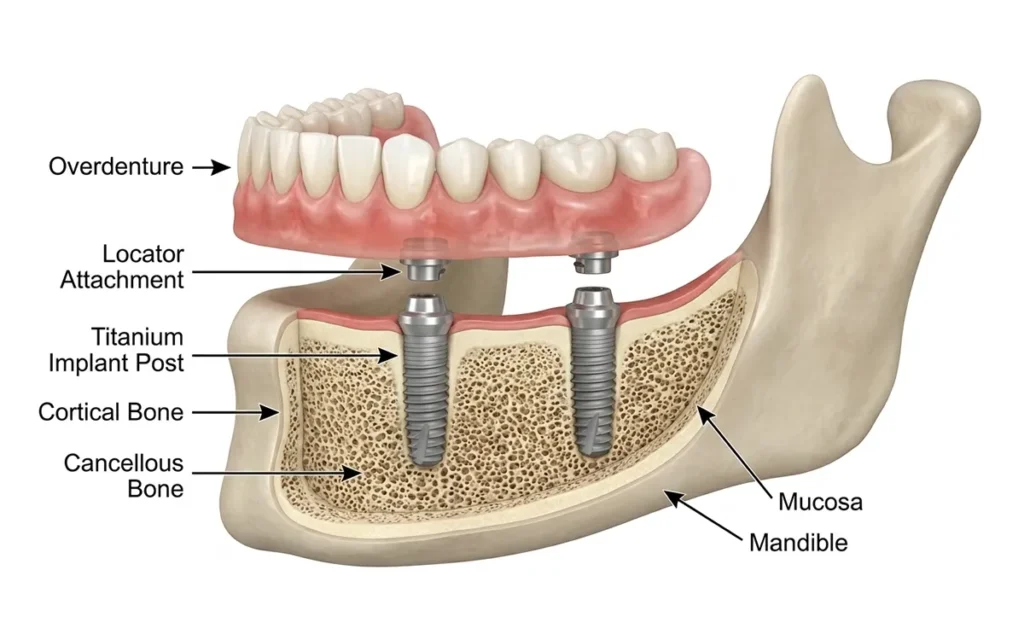
How Snap-In Implant Dentures Work
The Implant Foundation
Two to four titanium implants are placed in the jawbone at strategic positions. Over the following months, those implants integrate with the bone through a process called osseointegration. Once fully integrated, they serve as a stable anchor system. Unlike a natural tooth root that exists only under one tooth, each implant post supports a broader load, and the denture designed around them can distribute biting force more efficiently than any surface-resting appliance.
The Snap Connection
The denture attaches to abutments on the implants via locator attachments, also called snaps. These click firmly into place and stay locked during eating and speaking. To remove the denture for cleaning, the patient presses a release mechanism and lifts it free. The stability difference compared to an adhesive-held conventional denture is not subtle. It’s the difference between an appliance that functions and one that requires constant management.
What to Expect at Misch
Step 1: Consultation and 3D Imaging
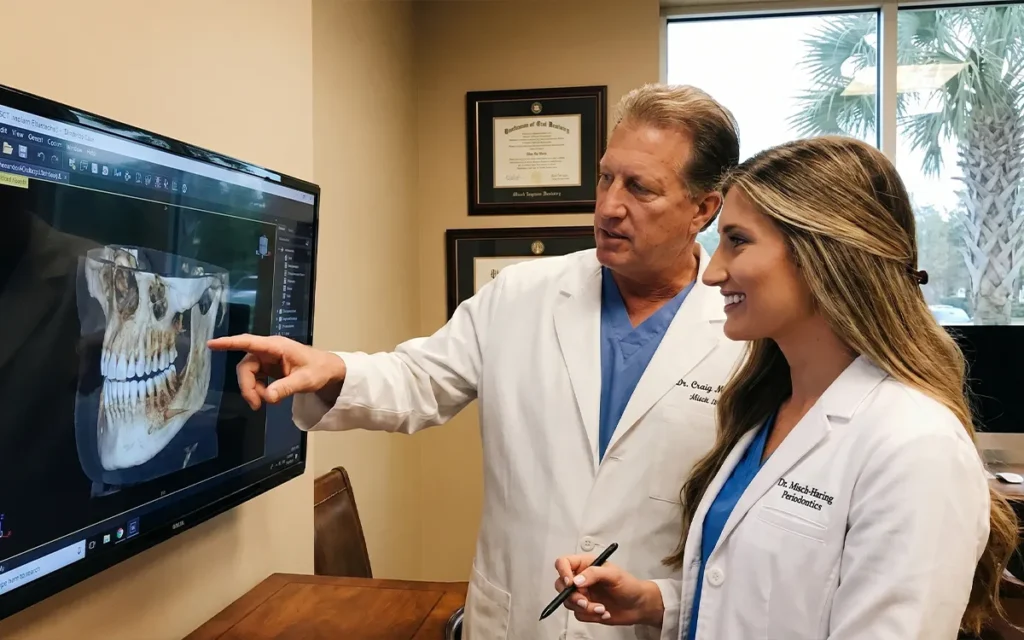
The first appointment includes a thorough exam and a cone beam CT scan that shows the jaw in three dimensions. We can see bone volume, density, anatomy, and exactly where implant placement makes sense. The consultation is a diagnostic conversation, and you’ll leave knowing whether you’re a candidate, what the treatment plan looks like, and what the timeline involves.
Step 2: Implant Placement
Dr. Maggie Misch-Haring, our board-certified periodontist, places the implants under local anesthesia. IV sedation is available for patients who prefer to be comfortable and unaware during the procedure. Post-operative discomfort varies by case and typically resolves within a few days, and most patients tell us the recovery was easier than what they’d imagined.
Step 3: Healing and Integration
The implants require time to integrate with the bone before they’re loaded with the final prosthetic. This typically runs three to six months. During this period, a transitional prosthetic keeps the patient comfortable and functional. It’s the same process that makes the final result stable for decades rather than years.
Step 4: Your Final Denture
Dr. Harry Haring designs and fits the final snap-in denture. Because the surgical and restorative doctors work together at Misch from the start of treatment planning, the final teeth are designed around the implant positions from day one, and the fit is exact. There’s no disconnect between what the surgeon placed and what the restorative specialist needs.
Snap-In Implant Dentures vs. Conventional Dentures
Both options address tooth loss. The differences show up in stability, bone health, and long-term function.
| Feature | Snap-In Implant Dentures | Conventional Dentures |
|---|---|---|
| Stability | Anchored to implants. Does not slip. | Rests on gum ridge. Requires adhesive. |
| Bone Health | Implants stimulate the jaw and slow resorption. | No root stimulation. Bone loss continues. |
| Chewing Function | Near-normal. Most foods are manageable. | Limited. Harder foods often avoided. |
| Confidence | Secure. No constant adjustment mindset. | Frequent awareness of fit and movement. |
| Longevity | Implants last decades. Attachments serviced over time. | Relines and remakes needed as jaw changes. |
| Maintenance | Remove nightly to clean. Implants stay in place. | Remove and soak nightly. |
| Candidacy | Requires adequate bone or grafting first. | Available to most patients without surgery. |
| Investment | Higher upfront. Lower long-term cost of ownership. | Lower upfront. Ongoing reline and remake costs. |
If you’ve been told conventional dentures are your only option, a second opinion with a specialist is worth the conversation. Bone volume issues that once made implants impossible are now routinely addressed with bone grafting.
Snap-In Overdentures vs. All-on-4: Which Fits Your Situation?
Both are implant-supported solutions for missing teeth, and both are available at Misch. The difference is whether the final teeth come out at night.
| Feature | Snap-In Overdenture | All-on-4 Fixed |
|---|---|---|
| Removable | Yes, patient removes it nightly for cleaning. | No, fixed in place permanently like natural teeth. |
| Implants Needed | Typically 2 to 4 per arch. | Typically 4 to 6 per arch. |
| Bone Requirements | More forgiving of lower bone volume. | Typically needs more available bone or grafting first. |
| Best For | Patients who want implant stability without the cost or bone requirements of a fixed arch. | Patients who want the closest match to natural, permanent teeth. |
Neither option is a downgrade from the other; they solve for different priorities. A consultation with 3D imaging tells you which one your bone volume and budget actually support, and whether starting with a snap-in overdenture now and moving to a fixed arch later is realistic for your situation.
Why Patients Choose Misch for Snap-In Dentures
A Surgeon and Restorative Specialist Under One Roof
Most dental practices refer implant surgery out, then bring patients back for the prosthetic work. That handoff is where complications accumulate: the surgeon never sees how the final teeth need to land, and the restorative specialist inherits a surgical result they had no input on. At Misch, Dr. Maggie Misch-Haring handles all implant surgery and Dr. Harry Haring designs the final prosthetic. They plan cases together from the first appointment, and that coordination is the difference between a functional result and an exceptional one.
Board-Certified Specialist Experience
Dr. Craig Misch is a board-certified oral surgeon and implantologist, and a trained prosthodontist, who has published textbooks on bone augmentation that are used in clinical training programs internationally. Dr. Maggie Misch-Haring is a board-certified periodontist who has co-authored peer-reviewed research on implant-supported procedures.
That depth of specialty knowledge means the consultation you get at Misch is different. The doctors reading your scan have placed hundreds of cases, reviewed the literature, and seen outcomes that come from a variety of approaches, and you’ll have everything you need before any decisions get made.
550+ Five-Star Reviews from Real Sarasota Patients
With 550+ Google reviews at 4.9 stars, the Misch team has a documented history of outcomes that patients talk about. Those reviews describe patients who came in anxious about a major procedure and left with a completely different relationship to their teeth. Read them before any decisions get made.
What Sarasota Patients Say About Snap-In Dentures at Misch
I've had implants done before but this one was a piece of cake.
“I’ve had implants done before but this one was a piece of cake. Doctor Maggie Misch and her team were very professional throughout my procedure. I would definitely recommend Misch dentistry to my friends and family. An added bonus was seeing Dr Maggie’s baby when I entered the office. It’s a wonderful experience—glad I saw your advertisement in my church bulletin.”
Nick Carpinelli
I walked in hoping for relief, but what I found was so much more.
“In recent years, I dealt with ongoing pain and trouble eating because of serious problems with my upper and lower teeth, like implant infections, molars falling out, bone loss, and an uneven bite. I walked into MISCH dental office simply hoping for relief, but what I found was so much more. Dr. Haring and Luis Flores from Midwest Dental Arts not only replaced the infected implants and treated my receding gums and bone loss, but they also crafted completely new crowns for both the upper and lower arches.”
Tina Tran
I live in Maryland but always plan for implant surgery to be done in Florida with Misch.
“As usual everyone at Misch Dentistry was cordial, prepared and professional. They were very helpful coordinating my procedure with my Cosmetic Dentist which was much appreciated. I live in Maryland most of the year but always plan for any implant surgery to be done in Florida with Misch.”
Harriett Haynes
Frequently Asked Questions About Snap-In Implant Dentures
Are snap-in dentures the same as implant-supported dentures?
Yes. The terms refer to the same treatment category. Snap-in dentures describes the mechanism (the locator attachments that click into implant abutments), while implant-supported dentures describes the structural principle. Overdenture and implant-retained denture are also used interchangeably in clinical contexts. On this page, we use snap-in dentures because that’s the most common phrase patients use when they’re researching their options.
How many implants are needed for snap-in dentures?
Most lower-arch snap-in dentures use two implants. Upper arches typically require four because the upper jaw has less bone density, particularly toward the back. The exact number depends on the anatomy visible in your 3D imaging, and that’s determined at the first appointment.
Is the placement procedure painful?
Placement is performed under local anesthesia, and IV sedation is available for patients who prefer to be comfortable and unaware during the procedure. Post-operative discomfort varies by case and typically resolves within a few days, and most patients tell us the recovery was easier than what they’d imagined.
How long do snap-in dentures last?
The snap attachments on the denture are serviceable components that wear over time. Replacing them is a straightforward in-office procedure, and the implants themselves, assuming stable bone health, are designed to last for decades. The implant stays. The attachment hardware gets serviced.
What does snap-in denture treatment cost at Misch?
Misch is a fee-for-service practice that does not participate in insurance networks. Treatment cost varies based on the number of implants placed, whether bone grafting is needed first, and the final prosthetic design. Cost is reviewed clearly during your consultation before any decisions are made. Some patients find partial reimbursement through their dental plan for surgical procedures.
Can I get snap-in dentures if I've had bone loss?
Bone loss is common in patients who have worn conventional dentures for years, and it doesn’t automatically rule out implant-supported dentures. When bone volume isn’t sufficient for direct implant placement, bone grafting creates the foundation. It adds time to the treatment plan, but it makes implants possible in cases where they wouldn’t otherwise be. The 3D scan at your first appointment tells us exactly what your jaw shows and what’s needed.
How often do the locator attachments need to be replaced?
The snap attachments are a serviceable part, not a lifetime part. Most patients need them replaced every 1 to 2 years depending on how often the denture goes in and out, and it’s a quick in-office procedure, not a new denture. The implants underneath are the part designed to last for decades. Think of the attachments as a wear item, like a watch battery, and the implants as the watch itself.
Can I switch to a fixed All-on-4 arch later if I start with a snap-in overdenture?
Often, yes, if your bone volume supports it and the original implants were placed with that possibility in mind. This is exactly the kind of question worth raising during your initial 3D imaging consultation, since planning for a possible future upgrade can change where and how the first implants are placed. It’s not guaranteed for every case, but it’s common enough that we plan around it when it’s realistic for your anatomy.
Ready to Find Out If Snap-In Dentures Are Right for You?
A consultation at Misch includes a full exam, 3D imaging when indicated, and a straightforward explanation of what your jaw shows and what your options are. You’ll leave knowing whether snap-in implant dentures are the right solution for your situation, what the timeline looks like, and what the complete plan involves.
Or call us directly at (941) 957-6444.
Serving patients from: Sarasota, Longboat Key, Lakewood Ranch, Siesta Key, Bradenton, Tampa, Fort Myers, and across Florida.