
Sarasota's Denture Specialists
Dentures & Implant-Supported Overdentures: Comfort, Stability, and Confidence
If you’re missing most or all of your teeth, you know the struggle. Traditional dentures slip when you eat, click when you talk, and require constant adhesive to stay in place. You’ve stopped ordering certain foods at restaurants. You cover your mouth when you laugh. What was supposed to restore your smile has become a source of daily frustration.
The good news? Today’s denture options are dramatically better than what your parents or grandparents wore. And for many patients, the real game-changer isn’t a better denture—it’s an implant-supported overdenture that snaps securely onto implants, eliminating the slipping and adhesives entirely while still being removable for easy cleaning.
At Misch Implant & Aesthetic Dentistry, our prosthodontists design every denture with one goal: restoring not just your teeth, but your confidence. Whether you choose a premium traditional denture or upgrade to implant-supported stability, you will work with specialists who understand that a denture is more than plastic and acrylic, but rather your smile, your ability to eat what you want, and your comfort in social situations.
Understanding Your Denture Options
Not all dentures are created equal, and what works best for you depends on your remaining teeth (if any), your jawbone health, your budget, and your lifestyle. Here is an honest look at the options available.
Complete (Full) Dentures
Complete dentures replace all teeth in an arch, whether upper, lower, or both. The denture base is custom-molded to fit snugly against your gums and palate, and the artificial teeth are positioned to look natural and function properly.
How they stay in place:
Suction (especially for upper dentures) and denture adhesive. The fit is crucial, meaning a well-made denture should stay reasonably stable without excessive adhesive, but most patients still use some for added security.
The reality:
Even the best traditional denture is a compromise, as it covers your palate (roof of the mouth), which affects taste. It can slip during eating or speaking, especially as your gums change shape over time. Most patients adapt, but it takes time and patience.
Best for:
Patients who want the lowest initial cost, those who are not candidates for implants due to medical conditions, or those who prefer a non-surgical option.
Partial Dentures
If you still have some healthy natural teeth, a partial denture fills the gaps while your remaining teeth provide stability and metal clasps or precision attachments anchor the partial to your natural teeth.
Advantages:
Less invasive than implants, preserves your remaining teeth, lower cost than implant options.
Considerations:
The clasps may be visible when you smile. Your remaining teeth do bear additional stress, which can accelerate their wear and the partial denture must be relined periodically as your mouth changes.
Best for:
Patients with several healthy remaining teeth who want an affordable, non-surgical solution.
Implant-Supported Overdentures (Snap-On Dentures)
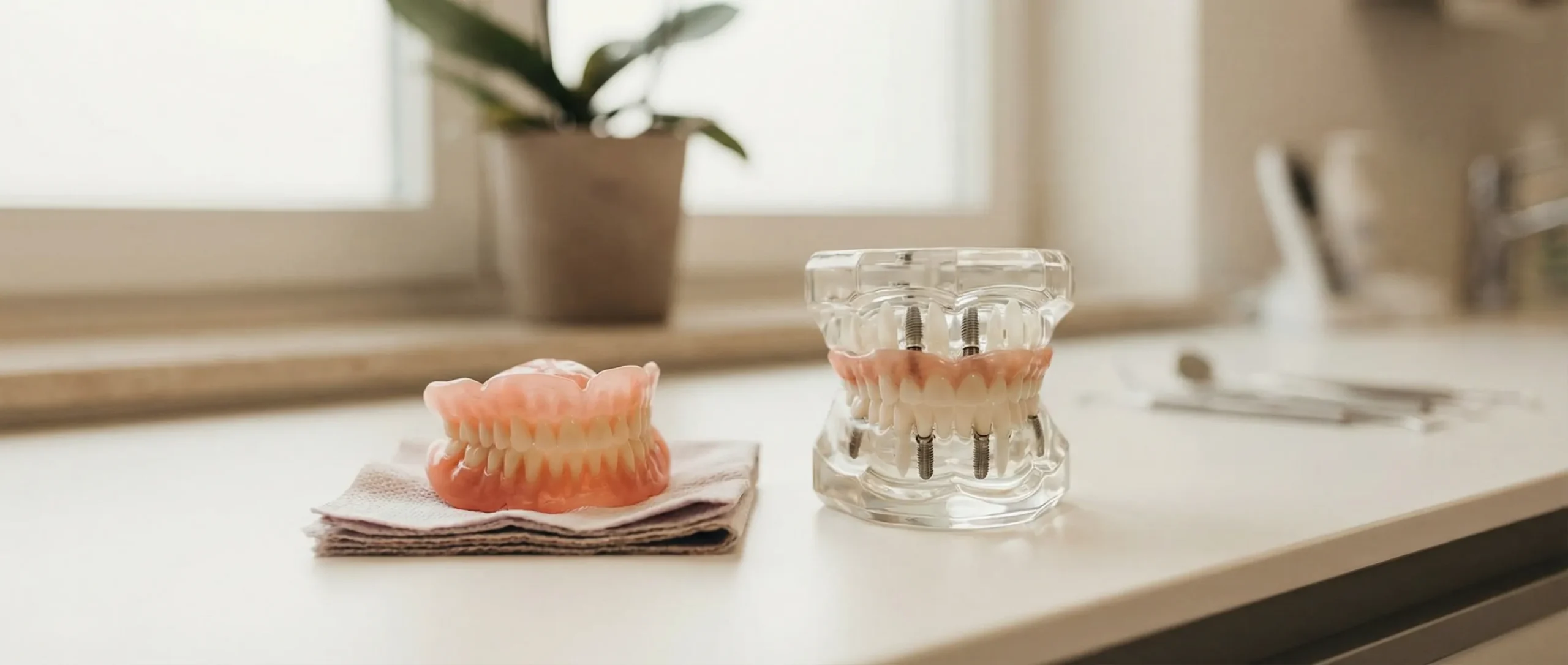
This is where modern dentistry transforms the denture experience. An implant-supported overdenture looks similar to a traditional denture but attaches to two to four dental implants placed in your jawbone. The denture "snaps" onto these implants, providing stability that traditional dentures simply cannot match.
How they work:
Special attachments on the underside of the denture click onto abutments connected to your implants, which allows the denture to stay firmly in place during eating and speaking, with the advantage that you can easily remove it for cleaning at night.
The transformation:
Patients who switch from traditional dentures to implant overdentures consistently describe it as life-changing: no more adhesives, no more slipping. You can bite into an apple, eat corn on the cob, and laugh freely without covering your mouth, and the upper overdenture can often be designed without palate coverage, restoring your ability to taste food properly.
Best for:
Patients frustrated with traditional denture instability, those who want significantly improved function without the investment of fixed implant teeth, and those who prefer the ability to remove their teeth for cleaning.
Fixed vs. Removable: Understanding the Difference
Some patients ask about "permanent" implant teeth, and that is a totally different solution. With full arch restoration (All-on-4), you receive teeth that are permanently fixed to implants and cannot be removed. They are brushed and flossed like natural teeth.
Implant overdentures are removable, meaning they snap on and off, which brings some advantages: easier cleaning, lower cost, and simpler repairs if something breaks. But if you want teeth you never remove, that is the full arch pathway.
Why Implant-Supported Overdentures Are Superior to Traditional Dentures
We believe in honest recommendations, so here is the truth: for most patients who can receive implants, an implant-supported overdenture offers a dramatically better quality of life than a traditional denture. Here is why:
Stability You Can Count On
Traditional dentures rely on suction and adhesive, and unfortunately both fail at the worst moments. Every denture wearer has a story about their dentures slipping at a dinner party or clicking during an important conversation.
Implant overdentures eliminate this problem: the denture clicks firmly onto your implants and stays there until you deliberately remove it. You can chew with confidence, speak clearly, and stop worrying about embarrassing moments.
Bone Preservation
When you lose teeth, the jawbone beneath them begins to shrink, which is a process called resorption. Traditional dentures actually accelerate this process because they press down on the gums and bone without providing the stimulation that keeps bone healthy.
Dental implants function like tooth roots, transmitting chewing forces into the bone and telling your body to maintain that bone volume. Over ten or twenty years, the difference is dramatic: patients with implant overdentures preserve far more bone than those in traditional dentures, which means better facial support and continued denture fit.
Improved Chewing Ability
Studies consistently show that implant overdentures restore approximately 80% of natural chewing ability, compared to only 20-25% for traditional dentures: that is the difference between avoiding steak and enjoying one.
No Palate Coverage (Upper Dentures)
Traditional upper dentures cover your entire palate, which affects taste and can trigger a gag reflex in some patients. Because implant overdentures gain their stability from the implants rather than suction, we can often design them without palate coverage, which is called a "horseshoe" design, meaning you will taste your food again and feel more natural.
When Traditional Dentures Still Make Sense
We wouldn't be honest if we didn't acknowledge that traditional dentures have their place. If medical conditions prevent you from having implant surgery, if your budget absolutely doesn't allow for implants, or if you simply prefer a non-surgical approach, a well-made traditional denture from a prosthodontist is still dramatically better than a budget denture from a general dentist or denture lab.
The Denture Process: What to Expect
We know that predictability brings peace of mind. Below, we detail every step of your journey so you feel secure, informed, and supported from start to finish.
Your Initial Consultation
Every denture case starts with a thorough evaluation. For this reason, we examine your remaining teeth (if any), assess your gum and bone health, take digital impressions and photographs, and discuss your goals and concerns.
If you are considering implant-supported overdentures, we will perform a CBCT scan to evaluate your bone volume and determine if implants can be placed directly or if bone grafting would be needed first.
Dr. Katherine Misch and Dr. Harry Haring, our prosthodontists, will explain all your options honestly. This includes costs, timelines, and what you can realistically expect from each approach.
Traditional Denture Timeline
If teeth need extraction:
We will coordinate the extractions and allow healing time (typically eight to twelve weeks) before final denture fabrication. During this healing period, you may wear an "immediate" denture so you are never without teeth.
Impression and fitting appointments:
Multiple visits are needed to capture precise impressions, try in wax models to ensure the right fit and appearance, and make final adjustments. This process takes about four to six appointments over several weeks.
Delivery:
Your final denture is delivered and adjusted perfectly. You will receive full instructions on care and adaptation, and follow-up appointments ensure everything fits properly as your mouth settles.
Implant Overdenture Timeline
Phase 1 (Surgical):
Dr. Craig Misch or Dr. Maggie Misch-Haring places two to four implants per arch. If you currently have no teeth, you can continue wearing your existing denture (modified to clear the implant sites) during healing.
Healing period:
The implants need time to integrate with your bone, which generally takes between three and six months. During this time, you wear a denture that applies no load to the implants while they bond.
Phase 2 (Restorative):
Once the implants have fully integrated, we attach the special abutments and create your final overdenture with snapping attachments. Dr. Katherine or Dr. Harry ensures the fit is perfect and your bite is comfortable.
Total timeline:
Approximately four to eight months from implant placement to final overdenture delivery.
Denture Cost: Understanding Your Investment
We prioritize financial transparency so you can plan your care without surprises. Below are realistic estimates that reflect the specialist expertise and premium material quality dedicated to your smile:
Traditional Denture Costs
Traditional Denture
$2,000 to $4,000 per arch
Premium traditional dentures at our practice range per arch. This includes all consultation appointments, impressions, try-ins, the final denture, and initial adjustments.
Why the price range? Material quality varies considerably. Premium teeth and high-quality acrylic cost more, but the result is a much more natural appearance and superior durability. Additionally, complex cases requiring extensive customization involve more laboratory time.
Implant Overdenture Costs
An implant-supported overdenture typically ranges from $8,000 to $15,000 per arch. This includes the implants, the surgery, and the overdenture itself.
Two-implant overdenture
$8,000-$10,000
(Lower arch only, not recommended for upper arch due to stability)
Four-implant overdenture
$12,000-$15,000 per arch
(Provides superior stability and is required for the upper arch)
This represents a significantly lower investment than a full arch fixed restoration, which costs between $25,000 and $35,000 per arch, while still providing most of the stability benefits. It is perfect for patients who do not mind removing their teeth for cleaning.
The Value Equation
Most dental insurance covers a portion of traditional dentures, typically 50% up to an annual maximum. Implant coverage varies widely from plan to plan. Some include implants, but many do not.
We provide detailed documentation for out-of-network reimbursement and work with healthcare financing companies offering 0% interest plans for qualified applicants. A quality denture solution should not be delayed because of budget concerns.
Insurance Information
Most dental insurance covers a portion of traditional dentures, typically 50% up to an annual maximum. Implant coverage varies widely from plan to plan. Some include implants, but many do not.
We provide detailed documentation for out-of-network reimbursement.
Three Prosthodontists, Two Surgeons: All The Expertise You Need Under One Roof
Not all dentures are created equal, and the difference starts with who designs them. Here is what makes our approach different:
Prosthodontist Expertise
Prosthodontics is the dental specialty focused specifically on replacing missing teeth, and dentures are at the heart of that specialty. Our prosthodontists, Dr. Katherine Misch and Dr. Harry Haring, completed three additional years of residency training specifically in complex restoration cases. They understand the nuances of denture design. From precise tooth positioning to gum contouring, these details make the difference between a denture that looks artificial and one that looks completely natural.
Honest Recommendations
We will not push the most expensive option if it is not right for you. Some patients are better served by a premium traditional denture while others genuinely need implant support. After your consultation, you will understand all your options with total clarity and feel confident in whatever decision you make.
All Specialists Under One Roof
If you need extractions before dentures, our oral surgeons perform them right here. If you choose implant overdentures, our surgical team places the implants while our prosthodontists design the final denture. If bone grafting is needed, we handle that too. You will never be referred out or need to coordinate between multiple offices because everything happens here with our family of specialists.
Premium Materials and Laboratory
We work exclusively with top-tier dental laboratories that use the finest teeth and acrylic materials available. The technicians who fabricate your denture are true artists who take pride in creating natural-looking results. This is not a mass-produced denture from a budget lab. It is custom-crafted to fit your face, your coloring, and your unique smile.
Denture FAQs
It is normal to have questions about the feel, fit, and longevity of dentures. With that in mind, we have gathered the most common concerns from our Sarasota patients to help you feel confident and informed about your next steps:
How long do dentures last?
Traditional dentures typically last five to seven years before needing replacement. This happens because the teeth wear down naturally and your jaw continues to change shape over time. Implant overdentures last longer, about ten to fifteen years for the denture component, because they do not press directly on your gums and experience less wear. The implants themselves can last a lifetime.
Can I sleep with my dentures in?
We generally recommend removing dentures at night to give your gums and bone a rest from constant pressure. This applies to both traditional dentures and implant overdentures. Soaking them overnight in a cleaning solution keeps your denture fresh and helps preserve its fit.
Will dentures look natural?
When designed by a prosthodontist using quality materials, absolutely. We carefully select tooth shapes and shades that complement your face, skin tone, and remaining teeth (if any). Many of our patients say people simply cannot tell they are wearing dentures.
How long does it take to adjust to dentures?
Most patients adapt to new dentures within two to four weeks. Eating and speaking feel different at first, so we recommend starting with soft foods and progressing gradually. Implant overdentures have a much shorter adjustment period because they do not move around like traditional dentures.
Can I get implant overdentures if I have been wearing traditional dentures for years?
Yes, in most cases you can. Even patients who have worn traditional dentures for decades can often receive implants. However, long-term denture wear causes some bone loss over time. Therefore, a CBCT scan is essential to evaluate whether you have sufficient bone or if grafting would be needed first.
What is the difference between snap-on dentures and All-on-4?
Snap-on dentures (implant overdentures) are removable, so you take them out for cleaning and sleeping. All-on-4 (full arch restoration) provides fixed teeth that stay in your mouth permanently and are brushed like natural teeth.
Snap-on dentures cost less and are easier to maintain. All-on-4 provides maximum stability and the closest feel to natural teeth.
Schedule Your Denture Consultation
Whether you are frustrated with your current dentures, facing the need for dentures for the first time, or curious about upgrading to implant-supported stability, we are here to help you understand your options.
During your consultation, we will evaluate your specific situation, explain what is possible for you, and create a plan that matches both your goals and your budget. There is no sales pressure, just honest information from specialists who genuinely care about restoring your smile.
Office Location:
Misch Implant & Aesthetic Dentistry
120 South Tuttle Avenue
Sarasota, FL 34237
Serving patients from: Sarasota, Longboat Key, Lakewood Ranch, Siesta Key, Bradenton, Tampa, Fort Myers, and across Florida.